

The best Soft Summer colors are muted, cool-neutral and softly blended.
Think dusty blue instead of electric blue, mauve instead of hot pink, cool taupe instead of golden camel and soft navy instead of very dark black.
But there is one important thing to understand:
Soft Summer does not mean pale pastel.
A Soft Summer palette can include medium and even fairly deep colors.
The defining quality is usually softness — not lightness.
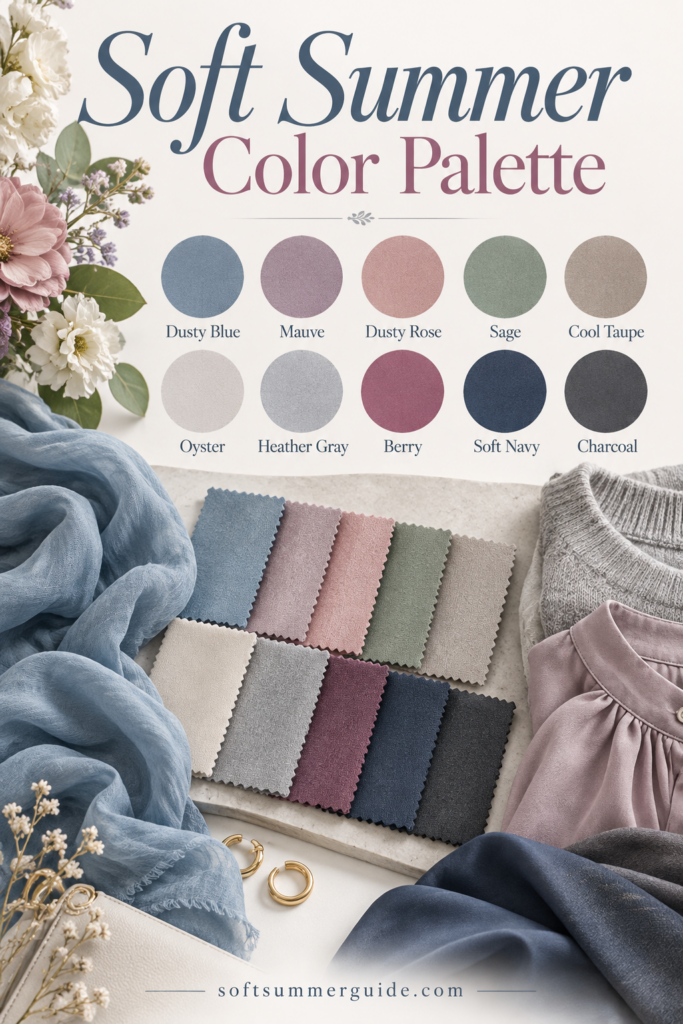
Some of the most useful Soft Summer colors include:
dusty blue, slate blue, mauve, dusty rose, berry, sage, eucalyptus, cool taupe, mushroom, heather gray, oyster, charcoal and soft navy.
If you’re still figuring out whether Soft Summer is actually your season, start with my complete guide:
Soft Summer Color Analysis: How to Tell If You’re a Soft Summer
And if you’re deciding between two muted seasons, this comparison will help:
Soft Summer vs Soft Autumn: How to Tell the Difference
Not sure whether these muted shades suit you better than the clearer or lighter Summer palettes?
Compare Soft Summer vs True Summer vs Light Summer.
What Colors Look Best on Soft Summer?
Soft Summer colors usually have three qualities:
- Muted
- Cool to cool-neutral
- Mostly medium in value
The first characteristic is especially important.
Soft Summer colors usually look as though a small amount of gray has been mixed into them.
That makes them quieter than clear colors.
For example:
- dusty blue instead of cobalt
- mauve instead of bright magenta
- sage instead of vivid emerald
- berry instead of scarlet
- soft navy instead of intense dark navy
The effect is sophisticated rather than bright.
The Soft Summer Color Palette in One Sentence
If you want the easiest possible rule:
Choose colors that feel smoky, softened and slightly cool rather than bright, golden or highly contrasted.
That doesn’t mean every color must look gray.
It means the color usually shouldn’t be extremely saturated.
What Makes a Color a Soft Summer Color?
There are three color characteristics worth understanding.
1. Mutedness
Mutedness describes how intense or saturated a color appears.
Compare:
bright royal blue
and
dusty blue.
Both are blue.
But the dusty version contains more softness and gray.
For Soft Summer, this difference is often more important than whether a color is technically light or dark.
2. Temperature
Soft Summer sits on the cool side of neutral.
That means the palette generally leans more toward:
blue than yellow
rose than peach
berry than orange-red
sage than olive
cool taupe than camel
But Soft Summer isn’t usually extremely icy.
That’s why slightly neutral shades such as taupe, mushroom and softened sage can work beautifully.
3. Value
Value simply describes how light or dark a color is.
Soft Summer usually sits around the light-to-medium and medium range, but many people can also wear deeper shades.
That is especially true if your own coloring is slightly deeper.
So don’t assume that every Soft Summer wardrobe has to consist of pale blue, lavender and light pink.
The Best Blue Colors for Soft Summer
Blue is one of the easiest color families for Soft Summer.
Look for blues that feel slightly gray, smoky or softened.
Some particularly useful shades include:
- dusty blue
- slate blue
- blue-gray
- denim blue
- storm blue
- smoky navy
A very clear royal blue can easily dominate Soft Summer coloring.
A dusty blue tends to sit much more naturally beside the face.
One practical example:
Dusty Blue Amazon Essentials sweater →
Use product photos as a starting point rather than an exact palette match, since colors can vary between screens, photography and dye lots.
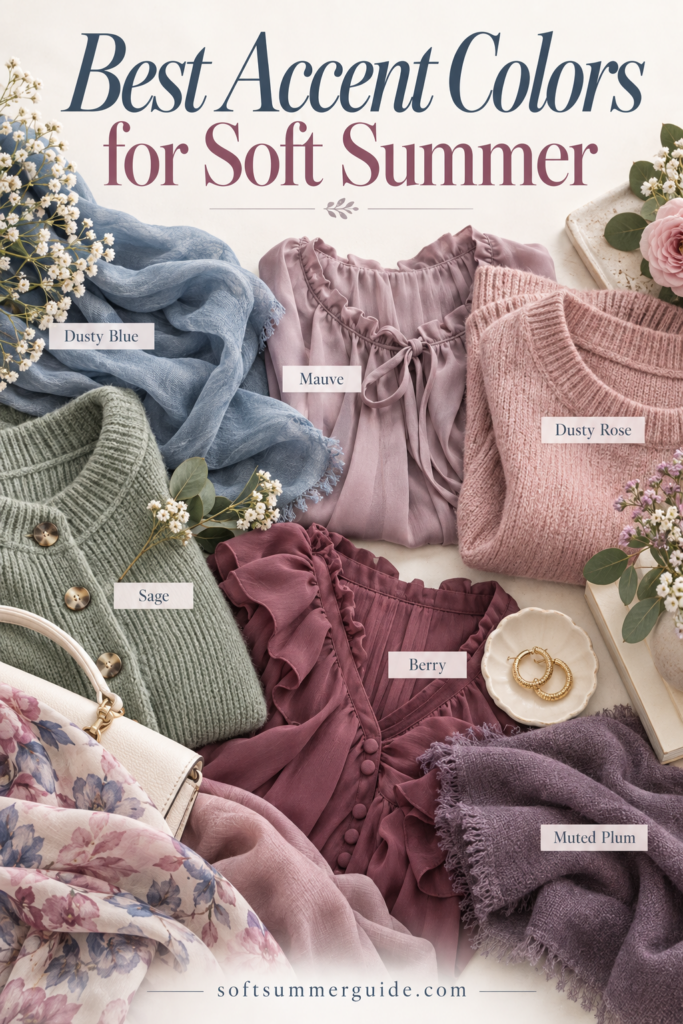
The Best Pink and Mauve Colors for Soft Summer
Pink can be surprisingly tricky.
Many commercial pinks are either very bright or noticeably warm.
Soft Summer usually does better with pinks that contain some gray, blue or mauve influence.
Look for:
- dusty rose
- mauve
- rosewood
- muted raspberry
- soft berry pink
- antique rose
If peachy pink makes your skin look slightly yellow or orange, compare it directly with dusty rose.
The difference may become much easier to see.
For example:
The Best Green Colors for Soft Summer
Green can work beautifully for Soft Summer.
The key is usually avoiding too much yellow.
Instead of golden olive, look toward:
- sage
- eucalyptus
- gray-green
- muted pine
- smoky blue-green
- soft sea green
If you’re unsure whether a green is leaning too warm, compare it directly with olive.
Soft Summer sage often feels slightly grayer and cooler.
Soft Autumn olive tends to contain more yellow or brown.
The Best Red and Berry Colors for Soft Summer
Soft Summer reds are rarely tomato red or bright scarlet.
Better directions include:
- berry
- raspberry
- cranberry
- soft wine
- muted burgundy
- rosewood
These shades provide depth without becoming overly bright or orange.
This is especially useful if you want stronger colors but don’t enjoy pastel clothing.
The Best Purple Colors for Soft Summer
Purple is another natural fit when it stays softened.
Try:
- mauve
- heather purple
- soft plum
- smoky violet
- muted lavender
- dusty lilac
The easiest options usually contain a little gray.
Very bright violet or highly saturated purple may feel much stronger.
Want the full palette?
Go deeper with the Soft Summer Color Guide
The 49-page Soft Summer Color Guide gives you a detailed visual reference for neutrals, accent colors, darker shades and practical color combinations — so you can compare colors instead of relying on vague names.
Explore the Color Guide · $19 →The Best Neutral Colors for Soft Summer
Neutrals are the foundation of an easy wardrobe.
If your neutral colors work together, almost every accent color becomes easier to combine.
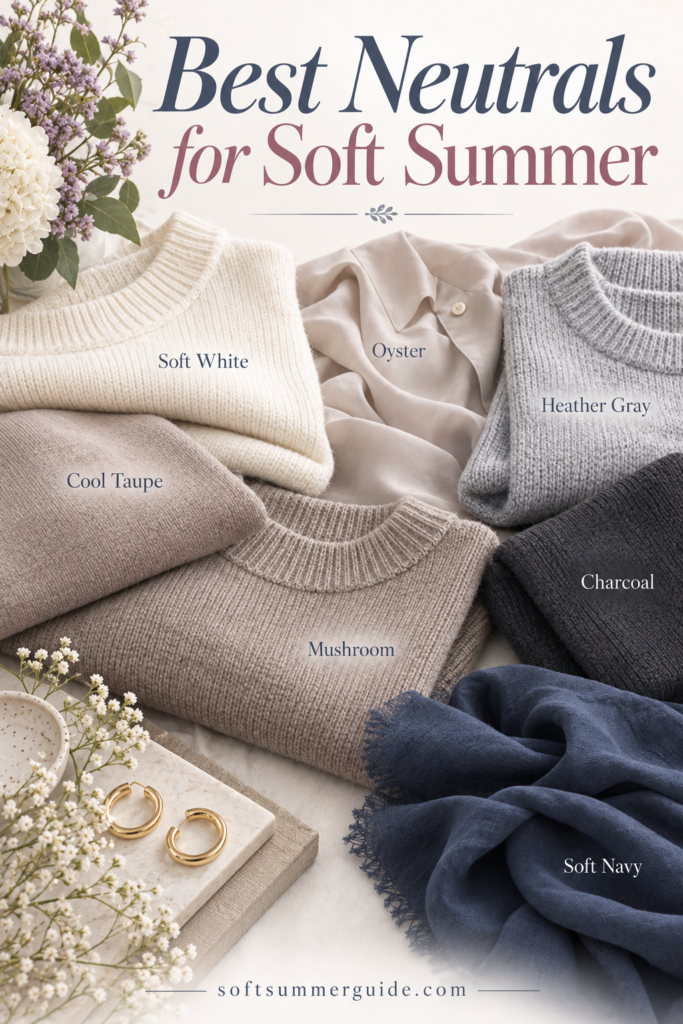
For Soft Summer, some of the most useful neutrals are:
- oyster
- soft white
- heather gray
- smoky gray
- cool taupe
- mushroom
- charcoal
- soft navy
Let’s look at them more closely.
Oyster and Soft White
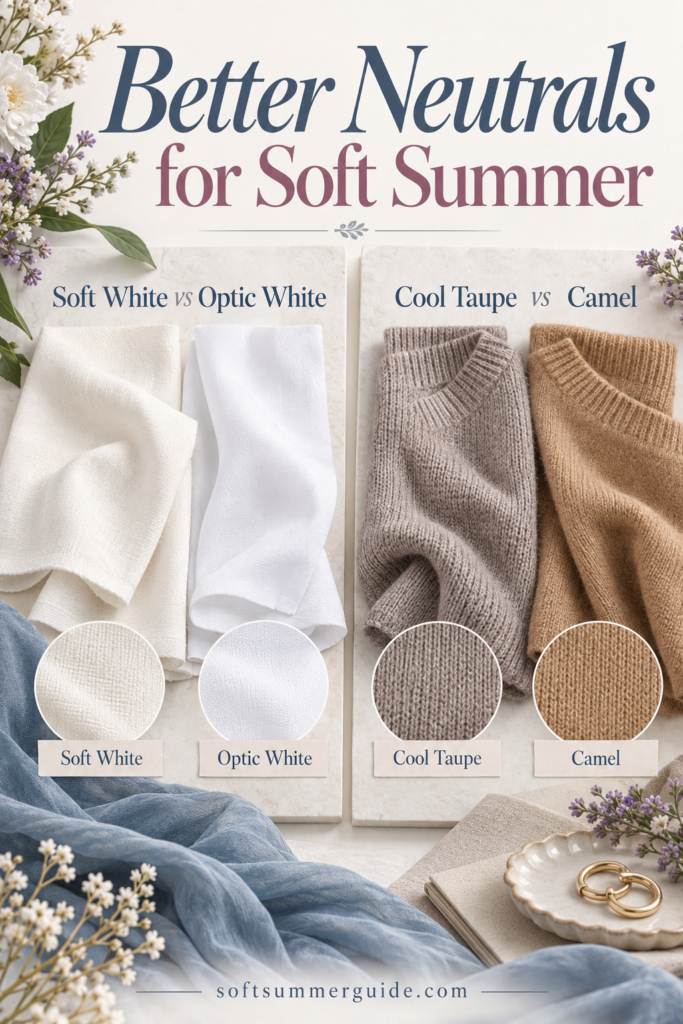
Pure optic white can create quite a lot of contrast.
Soft white and oyster usually feel less sharp.
Oyster is particularly useful because it sits somewhere between white, beige and gray.
It pairs easily with:
- dusty blue
- mauve
- berry
- soft navy
- cool taupe
- sage
A practical example:
Heather Gray
Gray is one of the easiest Soft Summer wardrobe neutrals.
Heathered or slightly smoky versions are especially useful because they already contain visual softness.
Try pairing heather gray with:
- mauve
- dusty rose
- dusty blue
- berry
- sage
- soft navy
Example:
Heather Gray Lands’ End cardigan →
Cool Taupe
Taupe is one of the best Soft Summer neutrals — and also one of the easiest colors to get wrong.
The word “taupe” is used for everything from gray-beige to warm caramel brown.
For Soft Summer, look for taupes that appear:
- grayish
- mushroom-like
- slightly mauve
- neutral-cool
rather than golden or orange-brown.
Example:
Mushroom
Mushroom is another excellent bridge between gray and beige.
It is especially useful if ordinary gray feels too cool but camel feels too warm.
Mushroom can work beautifully with:
- soft navy
- dusty rose
- sage
- mauve
- berry
- denim
Soft Navy
Soft navy is one of my favorite alternatives to black for Soft Summer.
It still provides structure.
But it usually creates less visual contrast than very dark black.
Use it for:
- blazers
- pants
- coats
- dresses
- shoes
- bags
Example:
Charcoal
Charcoal gives you the practical benefits of black while keeping the overall effect softer.
It works especially well with:
- dusty rose
- mauve
- soft white
- blue-gray
- berry
- cool taupe
Can Soft Summer Wear Black?
Yes.
Soft Summer does not need a forbidden-color list.
But black may create more contrast than your coloring naturally has.
Instead of asking:
“Am I allowed to wear black?”
try asking:
“Is black my best dark neutral, or does something softer work better?”
Compare black with:
- charcoal
- smoky navy
- deep slate
- muted plum
You may find that one of these alternatives makes your face more noticeable than the clothing.
If you love black, you can also keep it farther from your face.
Black pants, shoes and bags generally have less impact on your complexion than a black turtleneck.
Can Soft Summer Wear White?
Yes.
But bright optic white may be stronger than necessary.
Try:
- soft white
- oyster
- pearl gray
- cool cream
Place bright white and soft white directly next to your face.
The softer version often creates a more blended transition.
Can Soft Summer Wear Beige?
Yes — but beige is another word that covers a huge range of colors.
Look for beige shades that lean toward:
- mushroom
- greige
- cool taupe
- stone
- oyster
Avoid assuming that every beige or camel is automatically a neutral.
Some beige shades contain a lot of yellow or orange.
Can Soft Summer Wear Brown?
Absolutely.
Look for cooler or more muted browns such as:
- mushroom brown
- taupe brown
- gray-brown
- soft cocoa
- rose brown
Very golden cognac and orange-brown may be more difficult close to the face.
For shoes and bags, though, you often have more flexibility.
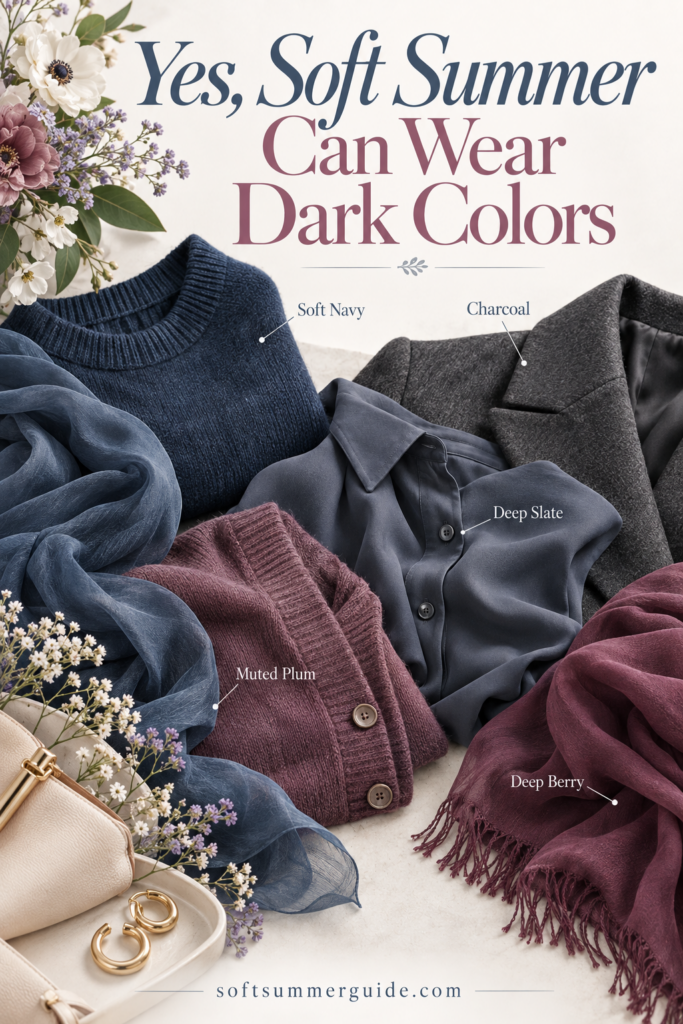
What Are the Best Dark Colors for Soft Summer?
Soft Summer can wear dark colors.
They just tend to work best when they stay muted.
Try:
- soft navy
- charcoal
- deep slate
- muted plum
- deep berry
- smoky blue
The difference between Soft Summer and a brighter season is not simply that Soft Summer must stay light.
A deep color can still be beautifully muted.
Ready to browse?
Shop Soft Summer Colors
Browse practical starting points for soft white, dusty blue, mauve, cool taupe, gray, soft navy, shoes, bags and beauty products.
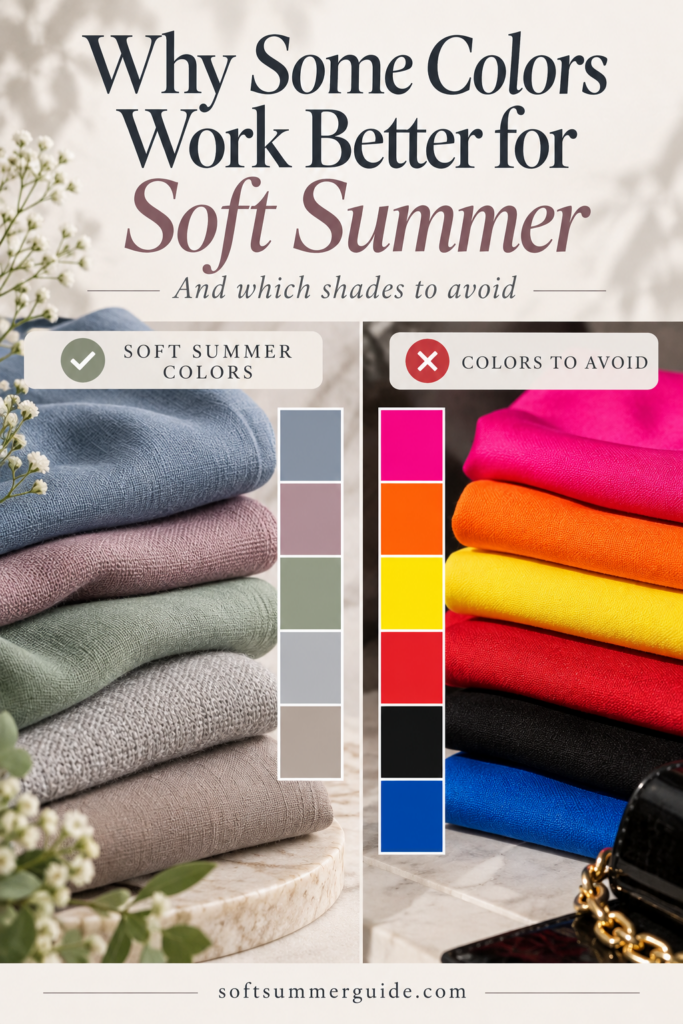
Shop Soft Summer Colors →What Colors Are Harder for Soft Summer?
I prefer to think in terms of more difficult rather than forbidden colors.
Colors that often create more tension include:
- very bright orange
- neon pink
- clear yellow
- strong mustard
- golden camel
- warm rust
- tomato red
- electric blue
- very bright emerald
stark black and optic white together
But context matters.
A color that feels overwhelming as a blouse may be perfectly fine as a small bag, shoe or pattern accent.
How Can You Tell If a Color Is Muted?
This is one of the most useful skills you can learn.
Ask yourself:
- Does the color look slightly smoky?
- Could I imagine gray mixed into it?
- Does it feel calm rather than electric?
- Does it blend with other muted colors rather than jumping forward?
A useful trick is to compare two versions of the same color.
For example:
- dusty rose next to hot pink
- dusty blue next to cobalt
- sage next to emerald
- berry next to scarlet
The muted version usually looks less intense.
Soft Summer Color Names Are Not Reliable
This is worth repeating because it makes shopping much easier.
A brand may call a color:
- “sage”
- “mauve”
- “taupe”
or
“dusty rose”
without the shade actually matching the Soft Summer palette.
One brand’s taupe may be beautifully cool.
Another may be almost camel.
The label does not matter.
The actual color does.
That’s why I always recommend comparing colors directly rather than memorizing names.
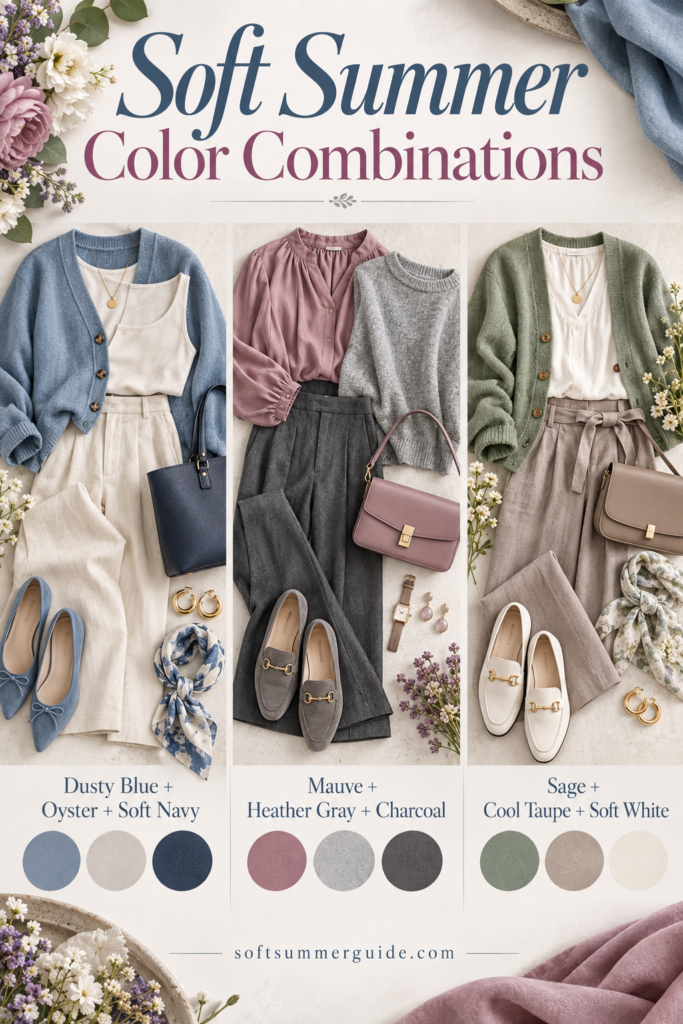
The Best Soft Summer Color Combinations
Once you have a small collection of reliable neutrals, creating outfits becomes much easier.
These combinations are good starting points:
- dusty blue + oyster + soft navy
- mauve + heather gray + charcoal
- sage + cool taupe + soft white
- dusty rose + mushroom + soft navy
- berry + charcoal + oyster
- slate blue + cool taupe + heather gray
- mauve + dusty blue + soft white
- sage + dusty rose + mushroom
- soft navy + oyster + dusty rose
- berry + smoky navy + cool taupe
Notice that these combinations don’t need extreme contrast.
The colors relate to each other.
That’s what makes the outfit look cohesive.
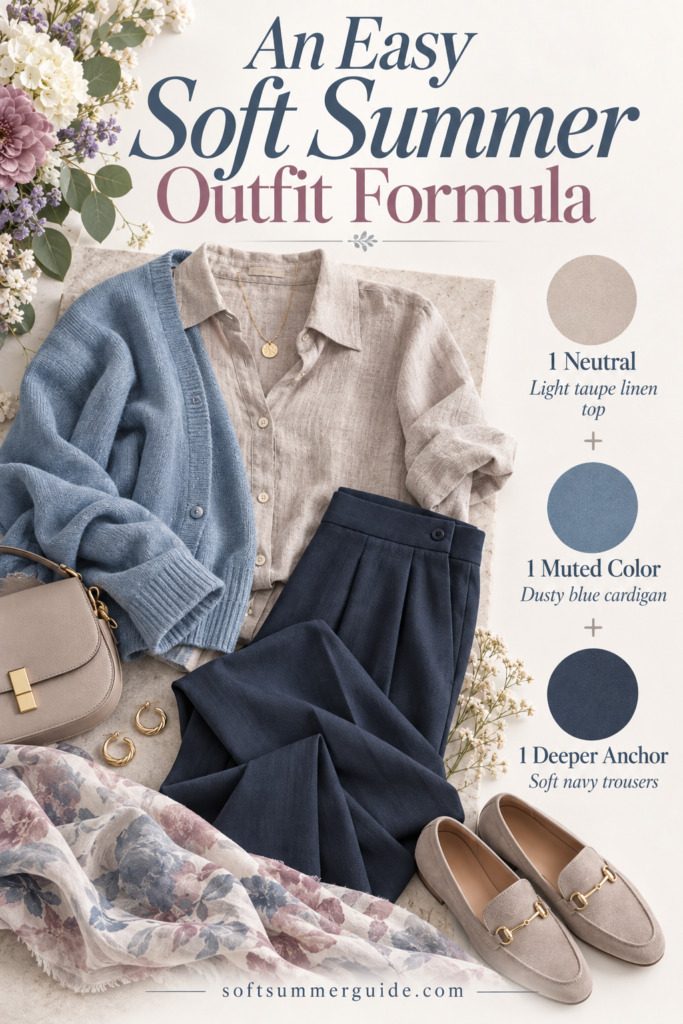
A Simple Soft Summer Outfit Formula
If building color combinations still feels complicated, use:
one neutral + one muted color + one deeper anchor
For example:
soft white shirt
- dusty blue cardigan
- smoky navy pants
or:
cool taupe trousers
- mauve top
- charcoal blazer
or:
heather gray pants
- sage sweater
- soft navy bag
You do not need six colors in every outfit.
Three is often enough.
A Soft Summer Wardrobe Doesn’t Need Every Palette Color
This is important.
You don’t need to buy dusty blue, mauve, sage, berry, plum, lavender, gray, navy and every other Soft Summer color.
A smaller personal palette is usually more useful.
For example, you could build around:
- soft white
- cool taupe
- heather gray
- soft navy
- dusty blue
- mauve
- berry
That already gives you dozens of combinations.
Your goal isn’t to collect colors.
Your goal is to make your clothes work together.
Real Soft Summer Shopping Examples
Here are a few starting points from the color families we’ve discussed:
Oyster:
Oyster sweater →
Heather Gray:
Heather Gray cardigan →
Dusty Blue:
Dusty Blue sweater →
Mauve:
Mauve top →
Taupe:
Taupe sweater →
Soft Navy:
Soft Navy blazer →
Taupe shoes:
Taupe ankle boots →
Taupe bag:
Taupe leather bag →
Affiliate disclosure: Some links in this article are affiliate links. As an Amazon Associate I earn from qualifying purchases, at no additional cost to you. Product photography, screens and dye lots can affect how a color appears, so these examples are visual starting points rather than guaranteed exact palette matches.
You can find more organized by color here:
Free Soft Summer resource
Take the Soft Summer Shopping Guide with you
A practical visual reference for your phone so you can compare colors while shopping instead of trusting vague color names.
Get the Free Shopping Guide →How to Build Your Own Soft Summer Palette
You don’t need professional fabric drapes to begin.
Start with the clothes you already own.
Pull out the pieces you consistently enjoy wearing.
Then ask:
- Which colors repeat?
- Are they smoky or bright?
- Do they lean warm or cool-neutral?
- Are your favorite outfits high contrast or softly blended?
You may discover that you already have a personal Soft Summer palette without realizing it.
Then use new purchases to strengthen that palette rather than starting over.
What If Some Soft Summer Colors Look Bad on Me?
That’s normal.
Seasonal color palettes describe a direction.
They do not mean that every Soft Summer person will look equally good in every Soft Summer shade.
You may prefer deeper colors.
Someone else may look best in dusty pastels.
You might love blue and berry but feel uncomfortable in lavender.
That’s fine.
The most useful palette is the one that works with both your coloring and your real wardrobe.
Soft Summer Colors vs Soft Autumn Colors
The two palettes overlap because both are muted.
The easiest distinction is temperature.
Soft Summer leans toward:
- dusty rose
- mauve
- dusty blue
- sage
- cool taupe
- soft navy
- berry
Soft Autumn leans toward:
- muted peach
- warm rose
- olive
- camel
- warm taupe
- muted teal
- terracotta
If you’re still unsure which direction works better, read:
Soft Summer vs Soft Autumn: How to Tell the Difference
Frequently Asked Questions About Soft Summer Colors
What are the best colors for Soft Summer?
Some of the easiest Soft Summer colors include dusty blue, slate blue, mauve, dusty rose, berry, sage, eucalyptus, cool taupe, mushroom, soft navy, heather gray and oyster.
Is Soft Summer a pastel palette?
No. Soft Summer is primarily muted, not necessarily light. Medium and deeper shades such as soft navy, charcoal, berry and muted plum can work very well.
What are the best neutrals for Soft Summer?
Useful Soft Summer neutrals include soft white, oyster, heather gray, smoky gray, cool taupe, mushroom, charcoal and soft navy.
Can Soft Summer wear black?
Yes. Black isn’t forbidden, but charcoal, smoky navy or deep slate may create a softer effect close to the face.
Can Soft Summer wear white?
Yes. Soft white and oyster are often easier than very bright optic white.
Can Soft Summer wear beige?
Yes. Look for cooler beige shades such as greige, mushroom, stone and cool taupe rather than very golden beige or camel.
Can Soft Summer wear brown?
Yes. Mushroom brown, taupe brown, cocoa and gray-brown can work especially well.
Is navy a Soft Summer color?
A softened or smoky navy is one of the most useful Soft Summer dark neutrals.
Is sage green a Soft Summer color?
Yes, especially if the sage looks gray-green or cool-neutral rather than strongly yellow or olive.
Is mauve a Soft Summer color?
Mauve is one of the most characteristic Soft Summer colors because it combines pink or purple with gray and cool-neutral softness.
What is the darkest color a Soft Summer can wear?
There is no fixed darkest shade. Deep muted colors such as soft navy, charcoal, deep slate, muted plum and berry may all work.
How do I know if a color is muted?
Compare it with a brighter version of the same color. Muted shades usually appear softer, smokier and less saturated.
Make the palette practical
Stop memorizing colors. Start comparing them.
The Color Guide gives you the full Soft Summer color direction, while the free Shopping Guide gives you a simple reference you can keep on your phone.
0 Comments