
If you keep reading that Soft Summers are supposed to be pale, blonde and delicate — but that description doesn’t quite sound like you — you’re not alone.
A Soft Summer color analysis is less about matching a specific hair or eye color and much more about understanding how colors interact with your overall coloring.
The defining quality of Soft Summer is softness.
Soft Summer colors are muted rather than bright, cool to cool-neutral rather than strongly warm, and usually sit around a medium level of depth. The overall effect is blended rather than highly contrasted.
That means a Soft Summer can have blonde hair.
But she can also have medium brown or even fairly dark hair.
She may have fair skin, but she may also have skin that looks beige, olive or slightly yellow on the surface.
The question isn’t:
“Do I look like the typical Soft Summer photo?”
A much better question is:
“Do soft, slightly cool and muted colors create more harmony with my coloring than bright, warm or very high-contrast colors?”
That is what we’re going to figure out.
What Is a Soft Summer?
Soft Summer is one of the twelve seasons used in seasonal color analysis.
It belongs to the Summer family but sits close to Soft Autumn, which means it has some neutral influence rather than being extremely cool.
Its three main characteristics are:
Muted + cool-neutral + medium
Of those three, muted is usually the most important.
A classic Soft Summer palette includes colors such as:
- dusty blue
- slate blue
- smoky navy
- mauve
- dusty rose
- berry
- sage
- eucalyptus
- cool taupe
- mushroom
- soft white
- heather gray
These colors share something important: they don’t look intensely saturated.
Imagine adding a tiny amount of gray to a color. It becomes quieter, softer and slightly smoky.
That is the visual language of Soft Summer.
The Quickest Way to Recognize Soft Summer
If you want the short version, look for these three things.
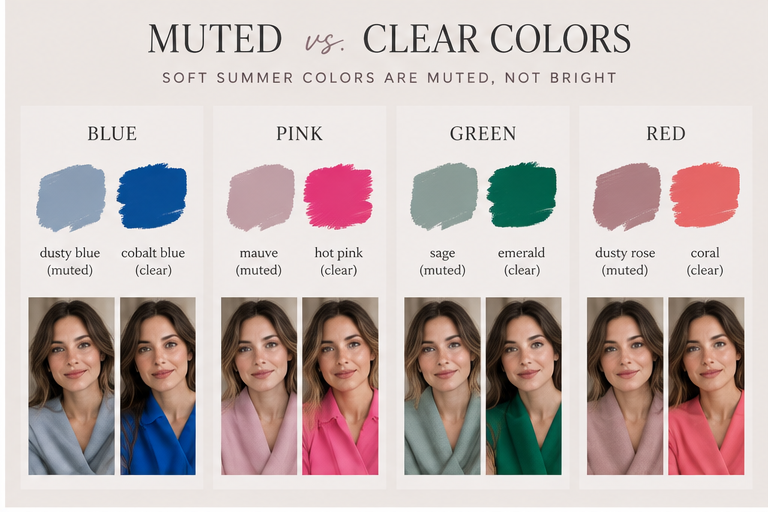
1. Muted colors look better than clear colors
This is usually the strongest clue.
Compare:
- dusty blue vs. cobalt blue
- rosewood vs. bright coral
- sage vs. emerald
- mauve vs. hot pink
A Soft Summer often looks more balanced in the first color of each pair.
The clearer color may appear to arrive in the room before you do.
The softer color tends to support your face instead.
2. Cool-neutral colors usually beat strongly warm colors
Soft Summer isn’t necessarily icy cool.
That’s why shades such as cool taupe, muted rose and eucalyptus can work beautifully.
But strongly warm colors such as pumpkin, mustard, rust, warm camel and orange-red often feel disconnected from the complexion.
3. Softer contrast usually looks more harmonious
Black and bright white create one of the strongest contrasts possible.
For many Soft Summers, combinations such as these feel easier:
- soft navy + oyster
- charcoal + dusty blue
- mushroom + mauve
- slate + soft white
You don’t have to eliminate dark colors. The goal is simply to make the transitions between colors less harsh.
You Don’t Have to Look “Light” to Be a Soft Summer
This is one of the most common misunderstandings about Soft Summer color analysis.
You do not need blonde hair.
You do not need pale blue eyes.
And you do not need extremely fair skin.
Soft Summer is not defined by one specific combination of physical features.
A woman with medium or darker brown hair may still be Soft Summer if her overall coloring responds best to muted, cool-neutral colors.
The same is true for someone whose skin appears olive, beige or slightly yellow.
Surface coloring and undertone aren’t always the same thing.
Someone can visually appear somewhat golden or olive while still finding that muted cool-neutral clothing creates much more harmony than strongly warm shades.
That’s why testing actual colors is much more useful than trying to diagnose your season from hair and eye color alone.
Not completely sure yet?
Start with the Soft Summer Starter Guide
The 32-page Starter Guide walks you through the Soft Summer palette, contrast, neutrals and the most important differences to neighboring seasons — without rigid rules or confusing color theory.
Explore the Starter Guide · $14 →Can Soft Summers Have Dark Hair?
Yes.
Dark hair does not automatically exclude Soft Summer.
What matters is how much visual contrast exists between your hair, skin and eyes — and how that contrast behaves when you add color.
Someone may have dark brown hair but still have relatively blended features overall.
The hair may also be softer in appearance than true black, with an ashy, smoky or neutral quality.
This is why rules such as “Soft Summers must have light brown or blonde hair” are too simplistic.
If you have darker hair, you may simply find that you can carry some of the deeper end of the Soft Summer palette especially well.
Think:
- smoky navy
- charcoal
- deep berry
- slate
- muted plum
The important part is that the color remains softened rather than extremely clear or harsh.
Can Soft Summers Have Olive or Yellow-Looking Skin?
Yes.
This is another area where online descriptions can create unnecessary confusion.
Olive skin does not automatically equal a warm season.
And skin that looks slightly yellow on the surface doesn’t necessarily mean your most flattering clothing colors will be warm.
The easiest way to test this is through comparison.
Place a warm camel near your face.
Then compare it with cool taupe.
Compare peach with dusty rose.
Compare olive-brown with muted sage.
If the softer, cooler option creates a more balanced effect, that tells you much more than the apparent color of your skin alone.
Soft Summer Is More About Mutedness Than “Pastels”
Soft Summer is sometimes reduced to a palette of pale pink, pale blue and lavender.
That’s misleading.
Soft Summer colors can absolutely be deeper.
The important distinction is not simply light versus dark.
It is:
muted versus clear
- A darker smoky blue can work beautifully.
- A bright electric blue may be much harder.
- A deep muted berry can look sophisticated.
- A brilliant scarlet may dominate.
- A charcoal gray can work better than stark black.
So if you’ve rejected Soft Summer because you dislike pale pastels, don’t rule it out yet.
The palette has much more range than that.
The Best Neutral Colors for Soft Summer
Neutrals are where Soft Summer wardrobes become especially useful.
Instead of building everything around black, pure white and warm camel, look at softer alternatives.
Soft White and Oyster
Soft white gives you the freshness of white without the extreme brightness of optic white.
Oyster is especially useful because it sits somewhere between white, gray and beige.
It often works beautifully with dusty blue, mauve, soft navy and taupe.
Amazon example:
Oyster sweater on Amazon
Heather Gray and Smoky Gray
Gray is one of the easiest Soft Summer neutrals.
The best versions often look slightly softened or heathered rather than hard and flat.
Amazon example:
Heather Gray Lands’ End cardigan
Cool Taupe and Mushroom
Taupe can be tricky because the word is used for both warm and cool colors.
Look for a version that feels slightly gray or mushroom-like rather than caramel or golden.
Amazon example:
Taupe ANRABESS sweater
Soft Navy
Navy is one of the easiest ways to add depth without immediately reaching for black.
A slightly softened navy can work as a jacket, pair of pants, dress, bag or shoe.
Amazon example:
Soft Navy blazer →
The Best Accent Colors for Soft Summer
Once your neutrals work together, accent colors become much easier.
Dusty Blue
Dusty blue is almost a signature Soft Summer shade.
It has enough color to be interesting but enough gray to remain soft.
Amazon example:
Dusty Blue Amazon Essentials sweater →Mauve and Dusty Rose
These colors are particularly useful if ordinary pink feels either too sugary or too bright.
Mauve contains a little more gray and purple, while dusty rose tends to feel muted and sophisticated.
Amazon example:
Mauve ANRABESS top →Sage and Eucalyptus
Green can work very well for Soft Summer when it isn’t too yellow.
Think gray-green rather than olive-brown.
Berry and Muted Plum
These are excellent alternatives when you want more depth.
They can create a richer look without leaving the muted quality of the palette.
Want the palette in more detail?
Keep your Soft Summer colors with you
The 49-page Soft Summer Color Guide goes deeper into neutrals, accent colors, darker shades, combinations and the differences between colors that look similar at first glance.
Explore the Color Guide · $19 →Can Soft Summer Wear Black?
Yes — but it may not always be the easiest dark neutral.
This is where I prefer to move away from rigid “allowed” and “forbidden” rules.
If you love black, you don’t need to throw it away.
Instead, notice its effect.
Does black make your face look more defined and sophisticated?
Or does your eye go to the black clothing first?
You may find that replacing some black with charcoal, smoky navy or slate creates a softer transition.
You can also make black easier by moving it farther from your face.
Black shoes, pants or a bag are usually less visually demanding than a solid black turtleneck directly underneath your face.
What About Bright White?
Bright optic white can create a similar problem.
The contrast may simply be stronger than your own natural coloring.
Try comparing it with:
- soft white
- oyster
- pearl gray
- cool cream
The difference can be surprisingly obvious when the fabrics are placed next to each other.
How Much Contrast Does Soft Summer Need?
Soft Summer is generally associated with low to medium contrast.
That doesn’t mean every outfit has to be pale or monochromatic.
It means the transitions between colors tend to work better when they aren’t extremely abrupt.
Compare:
black + pure white
with
charcoal + soft white
Or:
bright navy + white
with
smoky navy + dusty blue
The second combination in each example has a softer visual transition.
You can still create structure.
You simply create it with neighboring values and muted shades rather than extreme opposites.
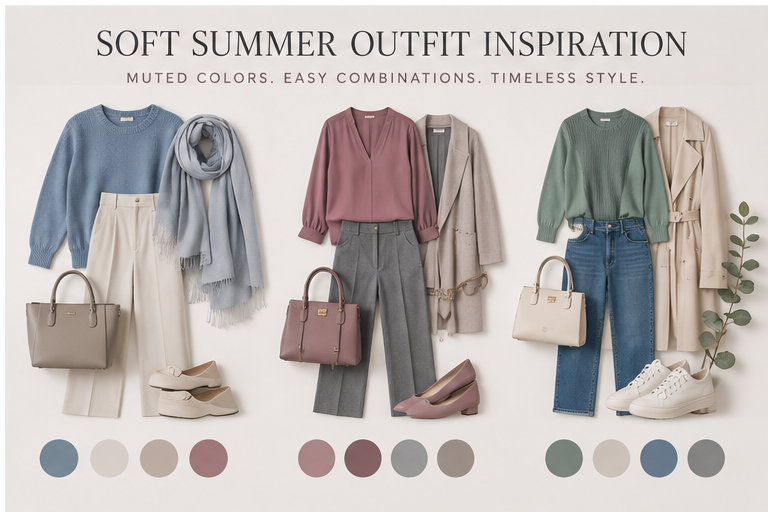
A Simple Soft Summer Outfit Formula
If you’re starting from scratch, use this formula:
one soft neutral + one muted color + one deeper anchor
For example:
cool taupe pants
- soft white top
- smoky navy blazer
or:
heather gray cardigan
- dusty rose shirt
- medium-wash denim
or:
mushroom trousers
- dusty blue sweater
- charcoal shoes
This approach is much easier than trying to build an entire wardrobe around dozens of individual palette colors.
How to Shop for Soft Summer Colors Without Memorizing a Palette
Color names aren’t reliable.
One brand’s “mauve” may be almost purple.
Another brand’s “taupe” may be warm brown.
And one “sage” may be beautifully muted while another is yellow-green.
So instead of asking:
“Is this officially a Soft Summer color?”
ask three questions.
Is it muted or very clear?
Does it lean cool-neutral or strongly warm?
Can I imagine wearing it with at least three things I already own?
That last question matters.
The goal isn’t simply to collect Soft Summer colors.
The goal is to build a wardrobe that actually works.
Want to start browsing actual products first?
Visit Shop Soft Summer Colors for Soft Summer-friendly searches in neutrals, dusty blues, mauves, taupes, shoes, bags and beauty.
Free guide
Take the Soft Summer Shopping Guide with you
A practical color reference for your phone so you can compare shades while shopping instead of relying on color names.
Get the Free Shopping Guide →What Makeup Colors Work for Soft Summer?
The same principles apply to makeup.
Very bright, warm or highly contrasting makeup can sometimes feel disconnected from Soft Summer coloring.
Try looking toward:
- rosewood and mauve lipstick
- cool rose or dusty pink blush
- taupe and gray-brown eye colors
- muted plum
- soft charcoal
- berry
Again, there are no universal rules.
The goal is to find colors that interact well with your individual complexion rather than simply buying something labeled “cool.”
For example, a mauve blush may work beautifully while an extremely blue-toned lipstick still feels too strong.
Soft Summer beauty
Not sure which makeup or hair colors to choose?
The 34-page Soft Summer Beauty Guide covers lipstick, blush, eyeshadow, complexion, hair color, nails and accessories with practical color directions you can actually use while shopping.
Explore the Beauty Guide · $19 →Soft Summer vs. Soft Autumn
Soft Summer and Soft Autumn are neighbors in the 12-season system.
Both are muted.
That is why they can be difficult to distinguish.
The main difference is temperature.
Soft Summer leans cool-neutral.
Soft Autumn leans warm-neutral.
A Soft Summer might prefer:
- dusty rose instead of muted peach
- cool taupe instead of camel
- slate blue instead of muted teal
- berry instead of terracotta
If you’re consistently drawn to muted colors but can’t decide whether you lean warm or cool, this comparison is usually more useful than comparing yourself with very bright seasons.
Soft Summer vs. True Summer
Both belong to the Summer family.
True Summer is generally more distinctly cool.
Soft Summer has more neutral influence because it sits closer to Autumn.
That means Soft Summer often handles colors such as mushroom, muted sage and cool taupe particularly well.
If icy or very cool colors seem slightly too sharp, while muted cool-neutral shades look better, Soft Summer may be the better fit.
Soft Summer vs. Light Summer
Light Summer is primarily influenced by lightness.
Soft Summer is primarily influenced by mutedness.
A Light Summer generally needs the palette to stay fairly light.
A Soft Summer can usually move further into medium and some deeper values — as long as the colors remain softened.
This distinction is especially important if you have darker hair and have assumed that you can’t belong to the Summer family.
The Best Way to Test Soft Summer at Home
Don’t try to determine your season from one photograph.
Instead, compare colors around your face in natural daylight.
You don’t need professional drapes to start.
Try clothes, scarves or even large pieces of fabric.
Compare:
- bright white vs. soft white
- black vs. charcoal
- camel vs. cool taupe
- coral vs. dusty rose
- bright royal blue vs. dusty blue
- orange-red vs. muted berry
The goal isn’t to decide which color you personally like more.
Watch your face.
Does one color make shadows, redness or unevenness more noticeable?
Does the other allow you to notice your eyes and facial features first?
Those are the differences you’re looking for.
Am I a Soft Summer?
You may be a Soft Summer if:
- muted colors consistently look more harmonious than bright colors
- cool-neutral colors generally work better than strongly warm ones
- medium and softly deep colors work well
- extreme black-and-white contrast feels harsh
- dusty blue, mauve, taupe, slate, sage and soft navy are easier to wear than vivid alternatives
- your overall coloring feels blended rather than sharply contrasted
But none of those clues should be judged in isolation.
Color analysis works best through comparison.
That’s why I created a quick free tool specifically for this question.
Take the free Am I a Soft Summer? Quiz
What If Some Soft Summer Colors Don’t Work for Me?
That’s completely normal.
A seasonal palette is a direction, not a collection of colors that every person has to wear equally well.
You may prefer the deeper end of Soft Summer.
Someone else may look best in the lighter neutrals.
You may love berry but dislike lavender.
You may prefer navy close to your face and keep pale pink for accessories.
Individual variation exists within every color season.
Use the palette to narrow down your choices — not to replace your own eyes.
Build Your Wardrobe Around Relationships Between Colors
This is where color analysis becomes genuinely useful.
The goal isn’t to own a closet full of individually flattering colors.
The goal is for those colors to work together.
If your neutral palette is built around soft white, heather gray, cool taupe and smoky navy, you can add dusty blue, mauve, sage and berry without having to reinvent every outfit.
That creates:
fewer isolated purchases
more outfit combinations
easier shopping
and a wardrobe that feels visually connected.
If your closet is already full but you still struggle to combine things, try my free Soft Summer Closet Check
It takes six quick questions and helps you identify where your wardrobe may be making things harder than necessary.
Soft Summer Color Analysis: The Most Important Thing to Remember
If you remember only one thing from this guide, make it this:
Soft Summer is not defined by being pale, blonde or pastel.
It is defined by how your coloring responds to mutedness, cool-neutral temperature and softer contrast.
Look at relationships instead of rules.
Compare similar shades.
Notice whether color supports your face or competes with it.
And don’t worry about making every decision perfectly.
The more colors you compare, the easier it becomes to recognize the pattern.
Frequently Asked Questions About Soft Summer
Can a Soft Summer have brown or dark hair?
Yes. Hair color alone does not determine your season. Someone with medium or darker brown hair can still be Soft Summer if muted, cool-neutral colors create the most harmony with her overall coloring.
Can Soft Summer have olive skin?
Yes. Olive or yellow-looking surface coloring does not automatically mean a warm undertone or warm season. Direct comparison between warm and cool-neutral colors is more useful.
Is Soft Summer always light?
No. Soft Summer is primarily muted, not necessarily light. Medium and some deeper softened colors can work very well.
Can Soft Summer wear black?
Yes. Black isn’t forbidden. However, charcoal, slate or smoky navy may create a softer and more harmonious effect, especially close to the face.
What is the best white for Soft Summer?
Soft white, oyster and slightly gray-white shades are often easier than very bright optic white.
What are the best Soft Summer neutrals?
Useful neutrals include soft white, oyster, heather gray, smoky gray, cool taupe, mushroom, charcoal and soft navy.
What colors should Soft Summer avoid?
Rather than creating a strict avoidance list, pay attention to colors that are extremely bright, strongly warm or very high contrast. Neon colors, vivid orange, golden camel and harsh black-and-white combinations may be harder to integrate than softer alternatives.
What is the difference between Soft Summer and Soft Autumn?
Both seasons are muted, but Soft Summer leans cool-neutral while Soft Autumn leans warm-neutral.
Your next step
Make Soft Summer easier to use in real life
Whether you’re just confirming your season or you’re ready to build a wardrobe around it, choose the guide that fits the question you’re trying to solve right now.
0 Comments