
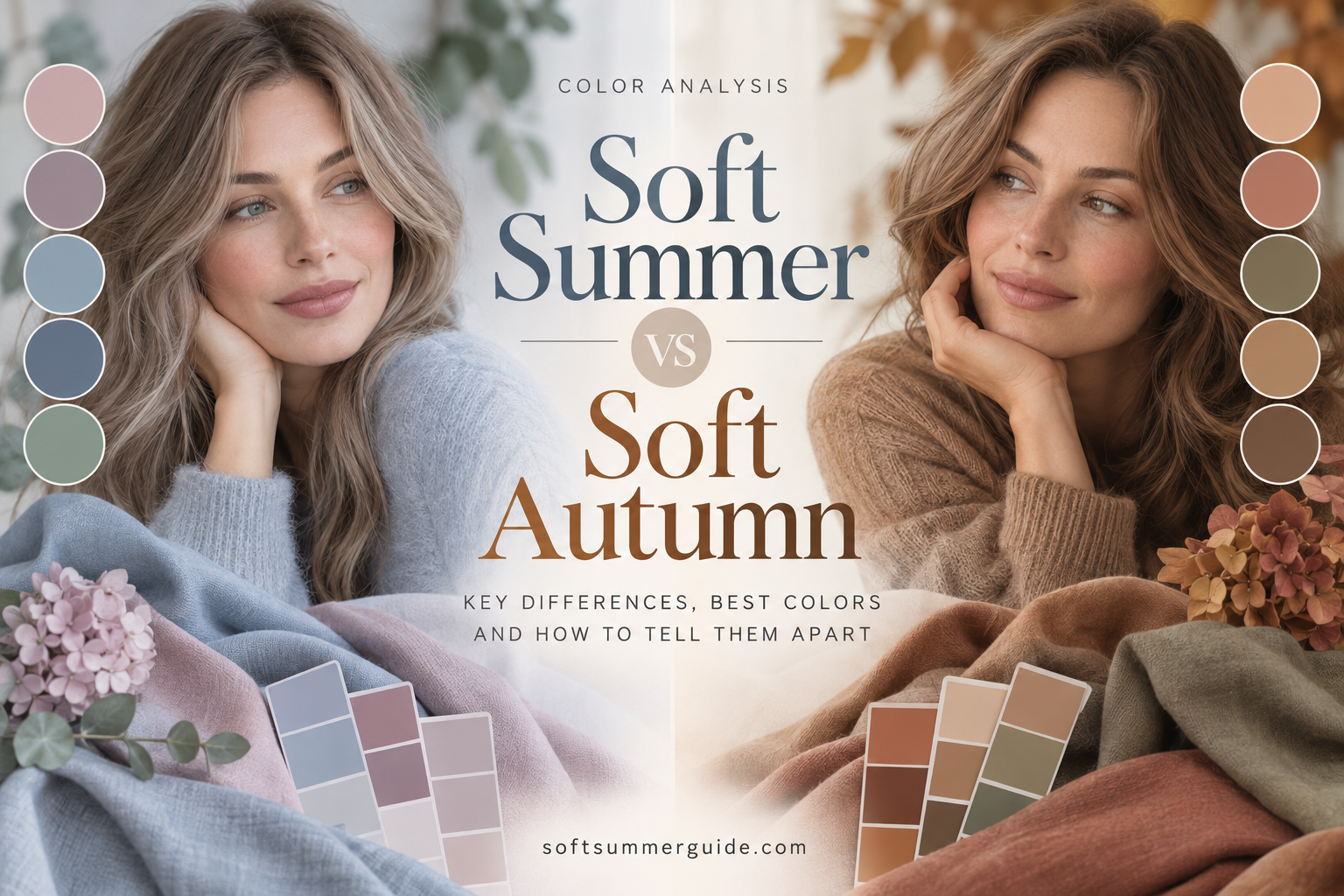
Soft Summer and Soft Autumn are two of the easiest color seasons to confuse.
And there is a good reason for that.
- Both seasons are muted.
- Both usually look better in softened colors than in extremely bright ones.
- Both tend to work well with medium contrast.
And both can include people with brown hair, beige or olive-looking skin and fairly neutral coloring.
The main difference is not how light or dark you are.
It is temperature.
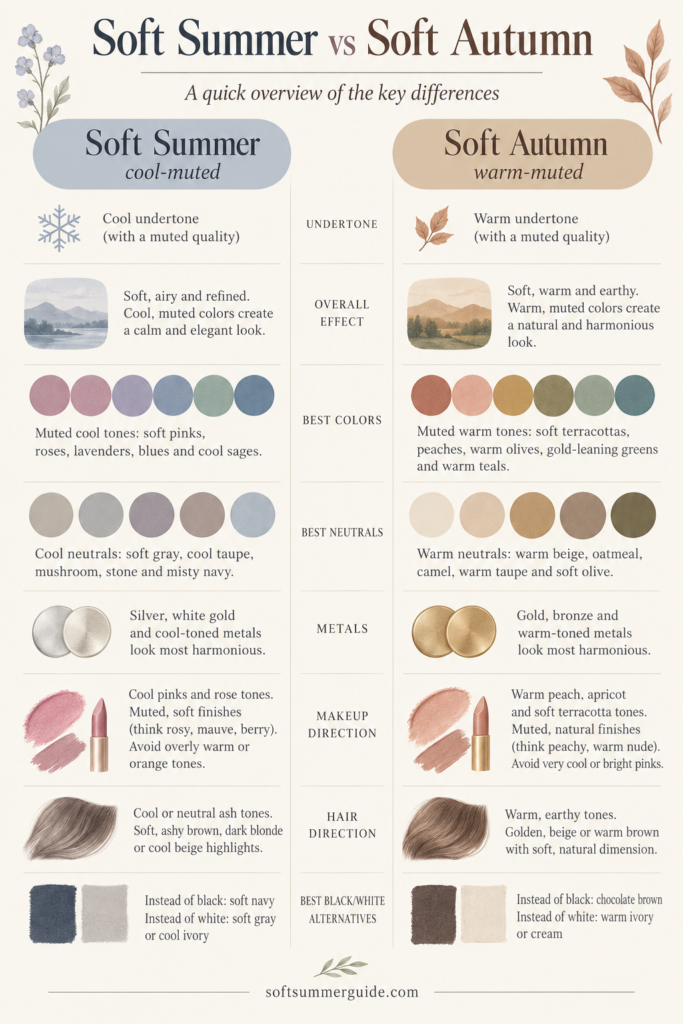
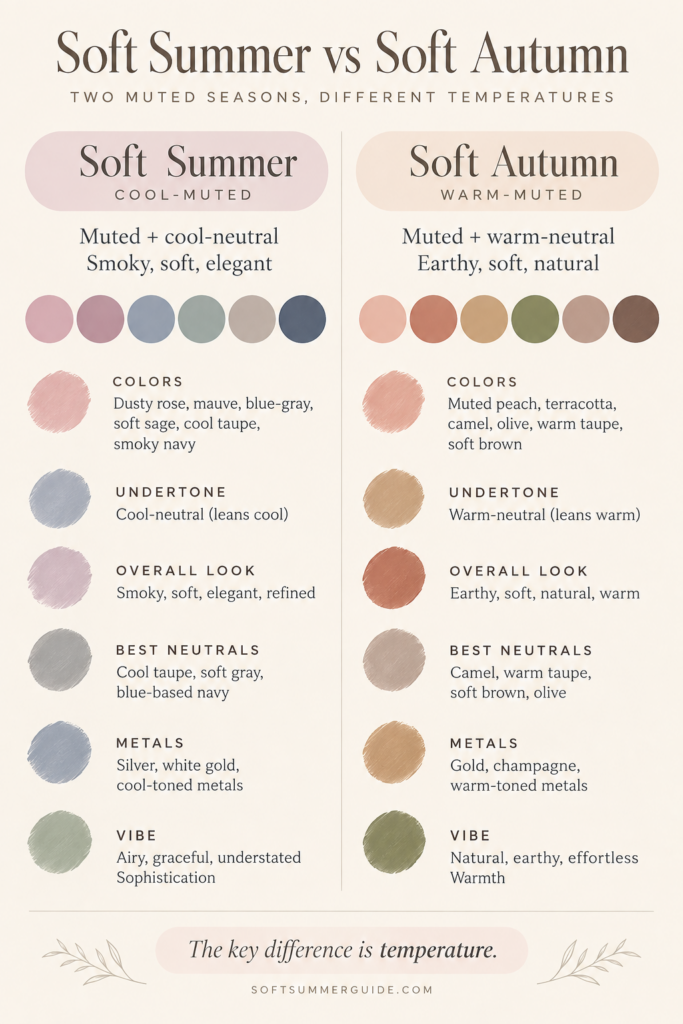
- Soft Summer is muted and cool-neutral.
- Soft Autumn is muted and warm-neutral.
If you already know that bright colors overwhelm you but still can’t decide whether you lean Summer or Autumn, this is the comparison that matters most.
If you’re still unsure whether Soft Summer fits you at all, start with my full guide:
Soft Summer Color Analysis: How to Tell If You’re a Soft Summer
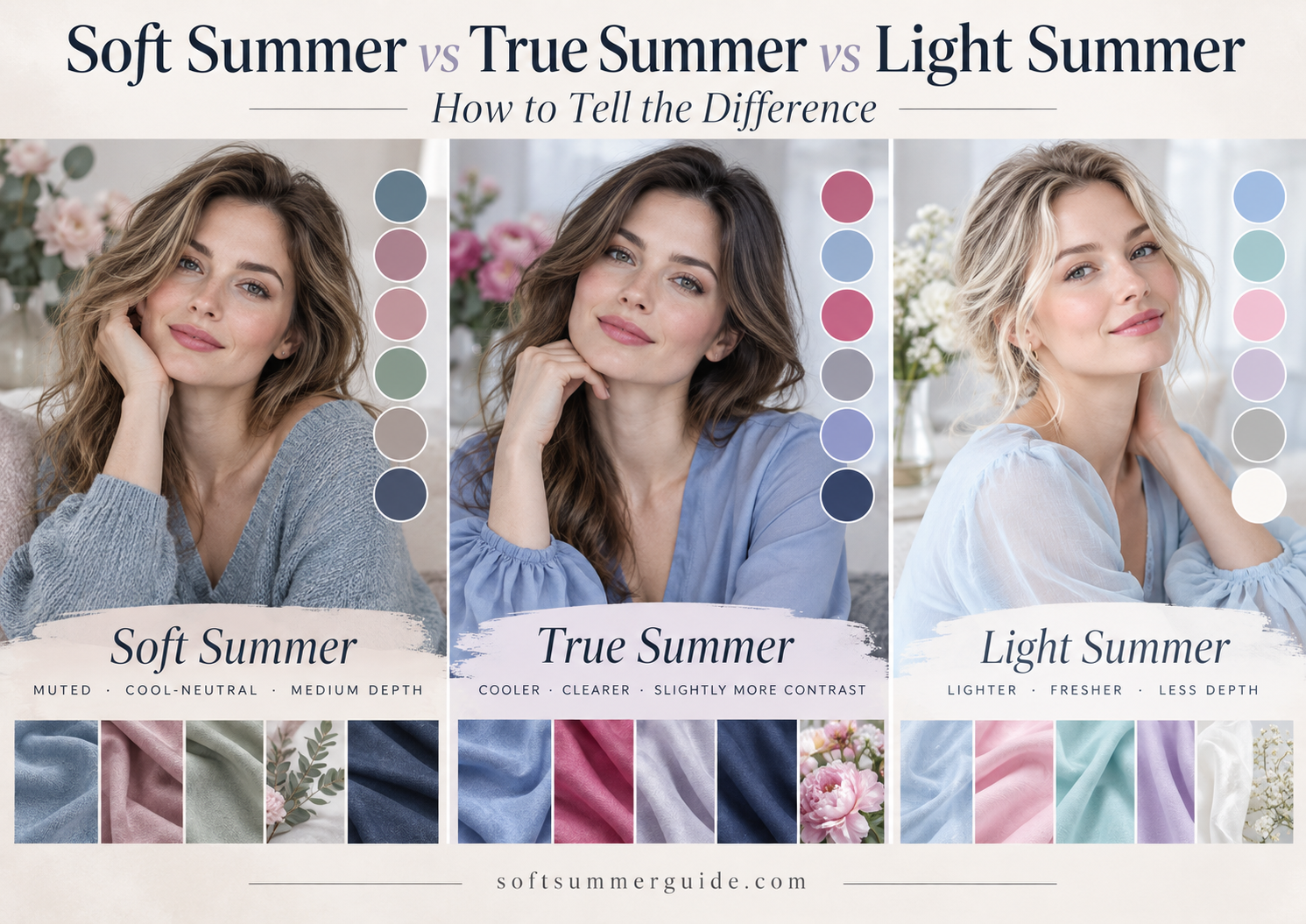
If you lean cooler but are still unsure which Summer season fits you best, take a look at Soft Summer vs True Summer vs Light Summer.
Soft Summer vs Soft Autumn at a Glance
Here is the simplest way to separate the two seasons:
| Soft Summer | Soft Autumn | |
|---|---|---|
| Dominant quality | Muted | Muted |
| Temperature | Cool-neutral | Warm-neutral |
| Overall effect | Smoky, soft, slightly cool | Earthy, soft, slightly warm |
| Best neutrals | Cool taupe, soft navy, heather gray, oyster | Warm taupe, camel, soft brown, cream |
| Pink direction | Dusty rose, mauve, rosewood | Muted peach, warm rose, terracotta rose |
| Blue direction | Dusty blue, slate, smoky navy | Muted teal, soft petrol, warm blue-green |
| Green direction | Sage, eucalyptus, blue-green gray | Olive, moss, muted khaki |
| Dark colors | Charcoal, smoky navy, muted plum | Chocolate, warm charcoal, deep olive |
| Metals | Silver, pewter, cool rose gold often feel easier | Soft gold, bronze, warm rose gold often feel easier |
The important word in both columns is still soft.
A very bright cool pink is not automatically a Soft Summer color.
And a very bright orange isn’t automatically a Soft Autumn color.
Both seasons need their colors to remain relatively muted.
The Biggest Similarity: Both Seasons Are Muted
Soft Summer and Soft Autumn sit next to each other in the 12-season color system.
That means they share a lot.
If clear cobalt blue, neon pink, brilliant orange or sharp black-and-white combinations overpower you, you may already know that your coloring needs more softness.
This is where people often get stuck.
They correctly identify:
“Bright colors don’t work for me.”
But then they still have to answer:
“Do I need my muted colors to lean cooler or warmer?”
That is the real Soft Summer vs Soft Autumn question.
The Biggest Difference: Cool-Neutral vs Warm-Neutral
Soft Summer sits on the cooler side of neutral.
Soft Autumn sits on the warmer side.
Neither season necessarily looks extremely cool or extremely warm.
That is why this comparison can be subtle.
A Soft Summer may still wear some muted greens, taupes and beige-like colors.
A Soft Autumn may still wear some blues and dusty pinks.
The difference becomes much easier to see when you compare two similar colors rather than asking whether one color is simply “good” or “bad.”
For example:
cool taupe vs camel
dusty rose vs muted peach
slate blue vs muted teal
berry vs terracotta
The best season is usually the one where the overall direction keeps your face looking calmer and more balanced.
Quick Answer: Soft Summer or Soft Autumn?
If you look better in mauve, dusty blue, cool taupe, soft navy and berry, Soft Summer is more likely.
If you look better in muted peach, olive, camel, warm taupe and terracotta, Soft Autumn is more likely.
But don’t decide based on one color.
Look for a pattern across several comparisons.
Can Soft Summer and Soft Autumn Look Physically Similar?
Absolutely.
This is one of the reasons online color analysis can become confusing.
Both seasons can have:
- brown hair
- medium-depth coloring
- green, hazel, gray or blue eyes
- beige skin
- olive-looking skin
- fair skin
- fairly neutral undertones
You cannot reliably separate these two seasons by saying:
“Brown hair means Autumn.”
or:
“Blue eyes mean Summer.”
That is too simplistic.
The better test is to see what happens when you place cool-muted and warm-muted colors next to your face.
Can Soft Summer Have Warm-Looking or Olive Skin?
Yes.
Surface coloring can look warmer than the underlying color response.
Someone may have skin that appears beige, yellow or olive and still look more balanced in Soft Summer colors.
This is especially important if you have been told:
“You look golden, so you must be Autumn.”
Try the colors instead.
Compare:
- camel vs cool taupe
- muted peach vs dusty rose
- olive brown vs sage
- warm cream vs oyster
If the cooler options consistently make your skin look calmer, more even or less yellow, Soft Summer may still be the better match.
Still between two seasons?
Start with the Soft Summer Starter Guide
The 32-page Starter Guide helps you understand the Soft Summer palette, contrast, neutrals and neighboring seasons without relying on rigid hair, eye or skin-color rules.
Explore the Starter Guide · $14 →The Best Soft Summer vs Soft Autumn Color Tests
You don’t need dozens of fabric drapes to start.
A few well-chosen comparisons can tell you much more.
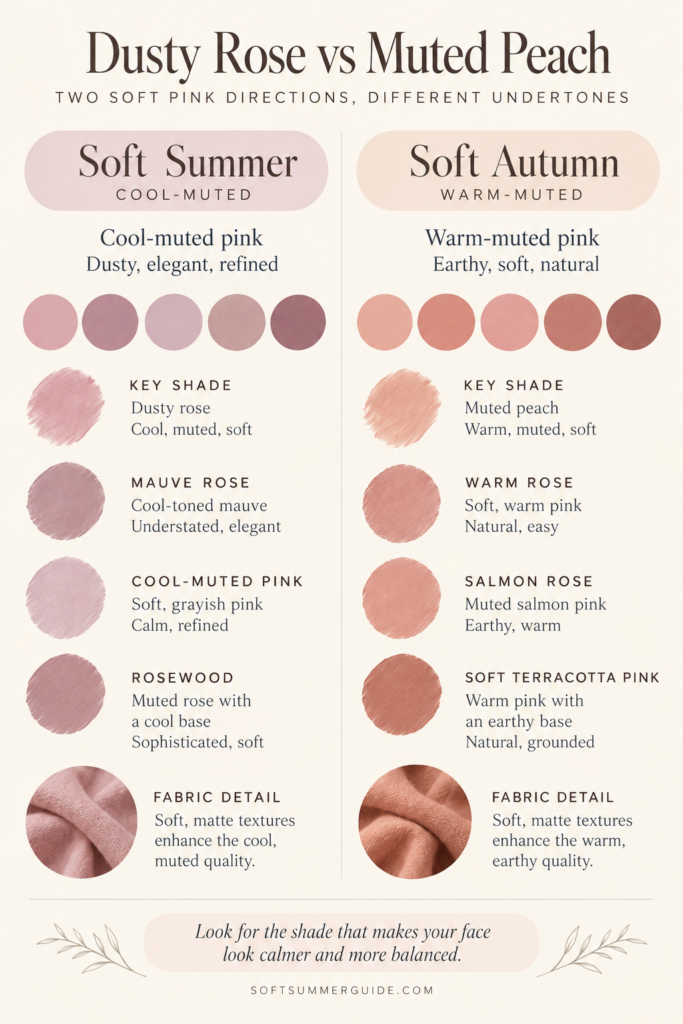
1. Dusty Rose vs Muted Peach
This is one of the easiest comparisons.
Soft Summer
Look for:
- dusty rose
- mauve rose
- rosewood
- muted berry pink
These colors contain more blue, gray or cool-neutral influence.
Soft Autumn
Look for:
- muted peach
- warm rose
- salmon rose
- soft terracotta pink
These shades contain more yellow or orange influence.
What should you watch for?
Don’t ask:
“Which color do I like?”
Instead look at your face.
Does one shade make redness, shadows or unevenness more noticeable?
Does the other make your eyes and facial features seem clearer?
That difference matters more than the color name.
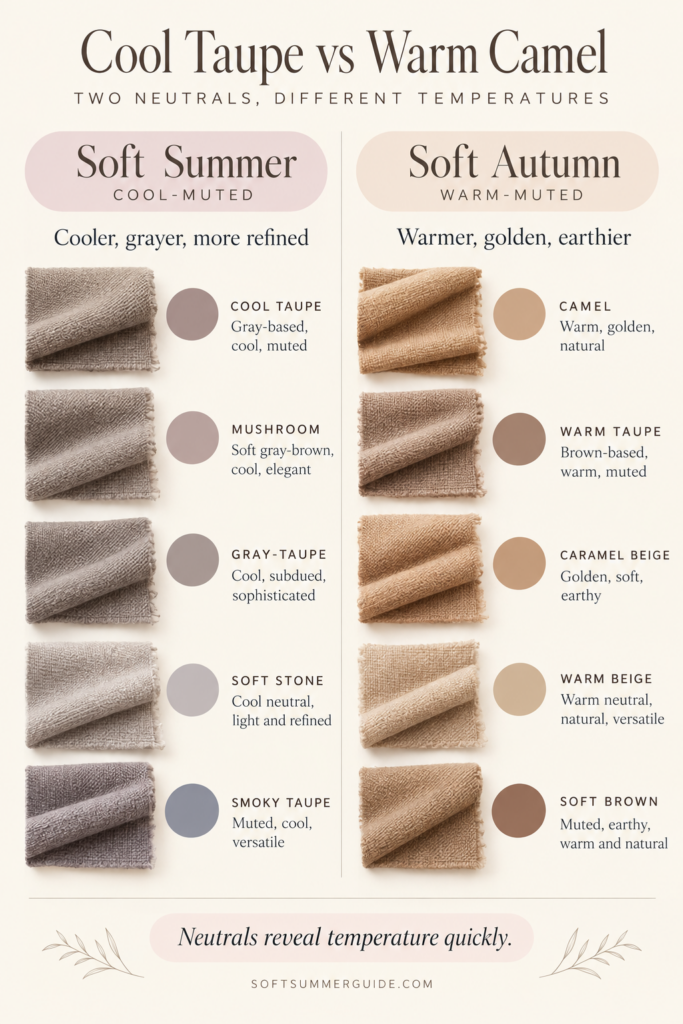
2. Cool Taupe vs Warm Camel
This is one of my favorite comparisons because neutrals reveal temperature very quickly.
Soft Summer
Cool taupe often works beautifully.
It usually has a gray, mushroom or slightly mauve undertone.
Soft Autumn
Camel and warmer taupes tend to feel more connected.
They may look slightly golden, brown or caramel.
If camel seems to make your skin look yellow or slightly dull while gray-taupe looks sophisticated, that is a strong Soft Summer clue.
If cool taupe makes you look washed out but muted camel gives you warmth and definition, Soft Autumn becomes more likely.
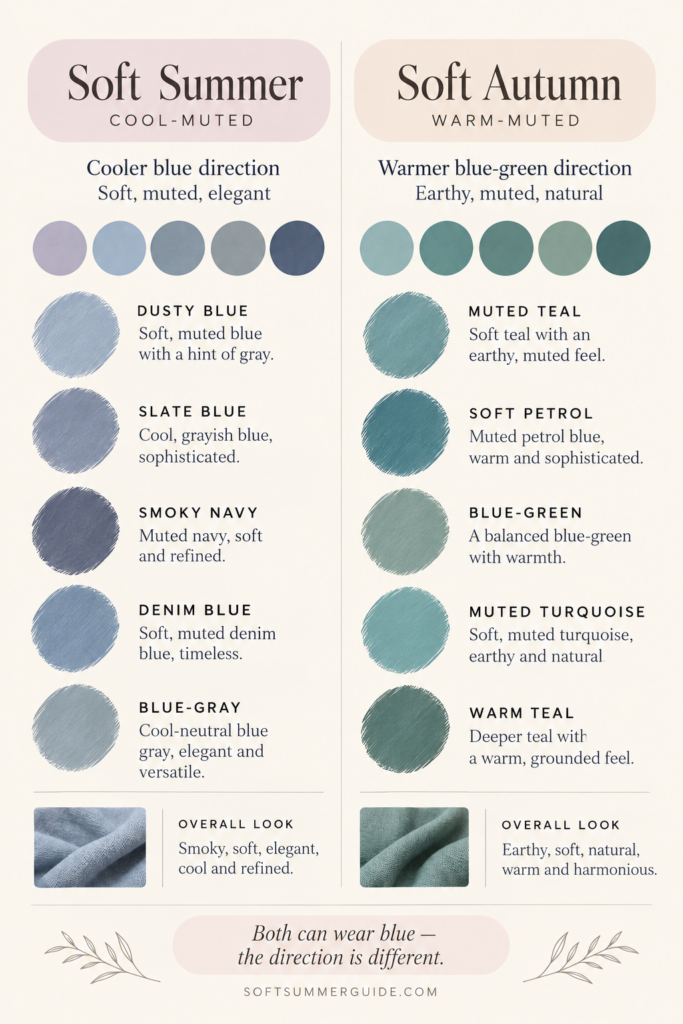
3. Dusty Blue vs Muted Teal
Both seasons can wear blue.
The difference is the direction of the blue.
Soft Summer
Often works well with:
- dusty blue
- slate blue
- denim blue
- smoky navy
- blue-gray
Soft Autumn
Often works well with:
- soft teal
- petrol blue
- muted turquoise
- warm blue-green
This comparison is especially useful if ordinary “cool vs warm” tests feel too obvious or artificial.
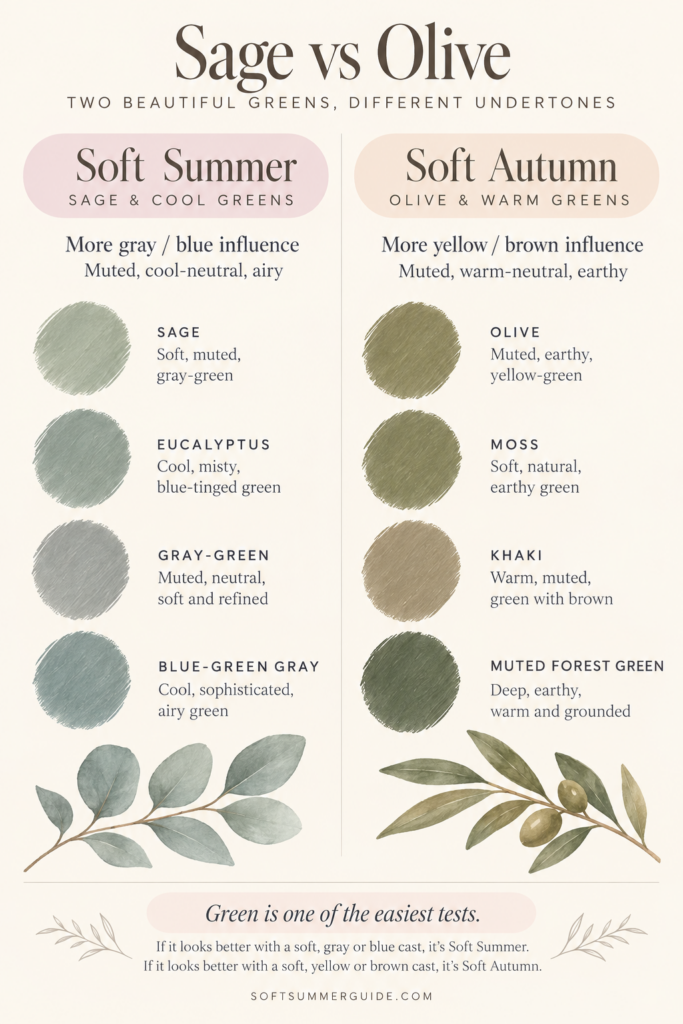
4. Sage vs Olive
Green is another very useful test.
Soft Summer
Think:
- sage
- eucalyptus
- gray-green
- soft pine
Soft Autumn
Think:
- olive
- moss
- khaki
- muted forest green
Both may look relatively soft.
But the Soft Summer version usually contains more gray or blue, while the Soft Autumn version contains more yellow or brown.
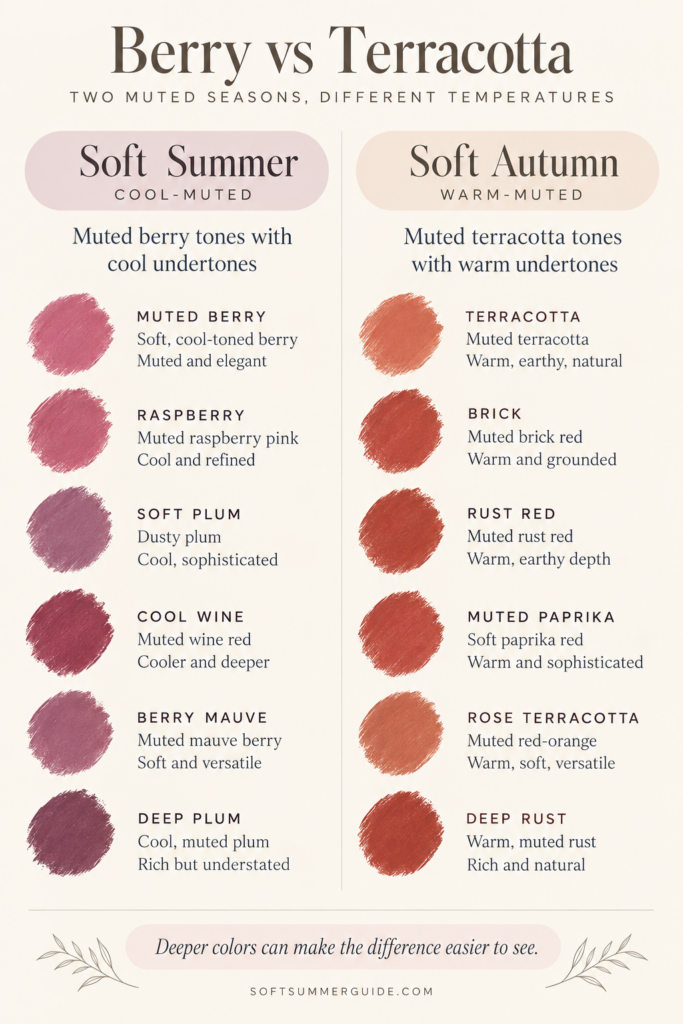
5. Berry vs Terracotta
If you like deeper colors, this test can be easier than pale colors.
Soft Summer
Try:
- muted berry
- raspberry
- soft plum
- wine with a cooler undertone
Soft Autumn
Try:
- terracotta
- brick
- warm rust-red
- muted paprika
If berry seems to brighten your face while terracotta makes your complexion look orange or yellow, that points toward Soft Summer.
If berry feels disconnected but terracotta looks rich and natural, Soft Autumn may be stronger.
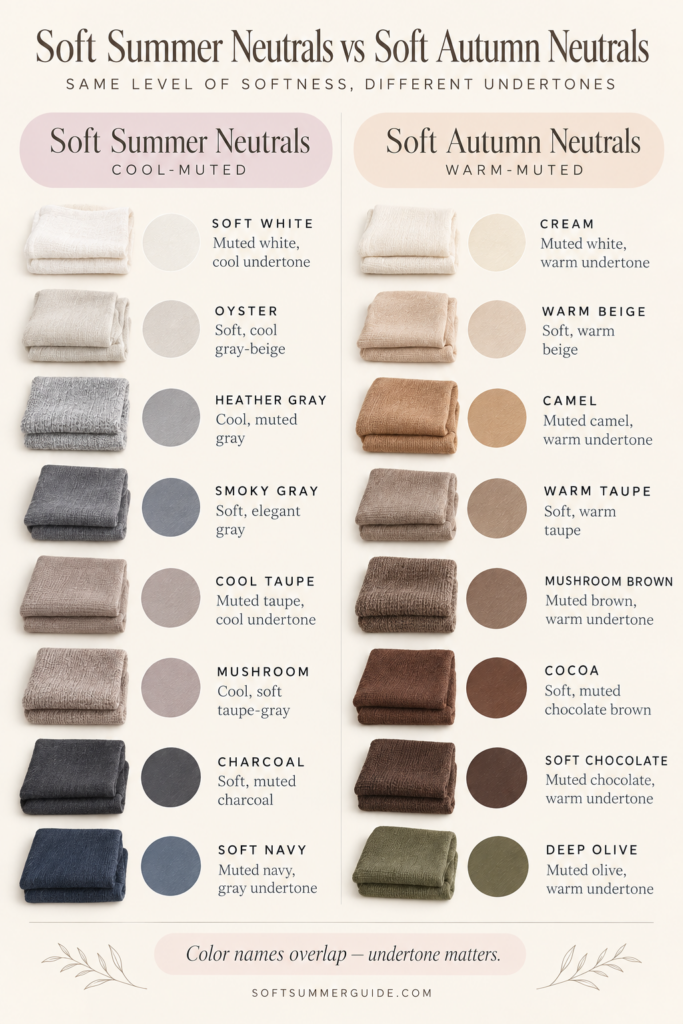
Soft Summer Neutrals vs Soft Autumn Neutrals
Your neutral wardrobe can tell you a lot.
Soft Summer neutrals
- soft white
- oyster
- heather gray
- smoky gray
- cool taupe
- mushroom
- charcoal
- soft navy
Soft Autumn neutrals
- cream
- warm beige
- camel
- warm taupe
- mushroom brown
- cocoa
- soft chocolate
- deep olive
Notice that mushroom and taupe can appear in both seasons.
The exact undertone matters.
That is why shopping by color name alone rarely works.
What About Black and White?
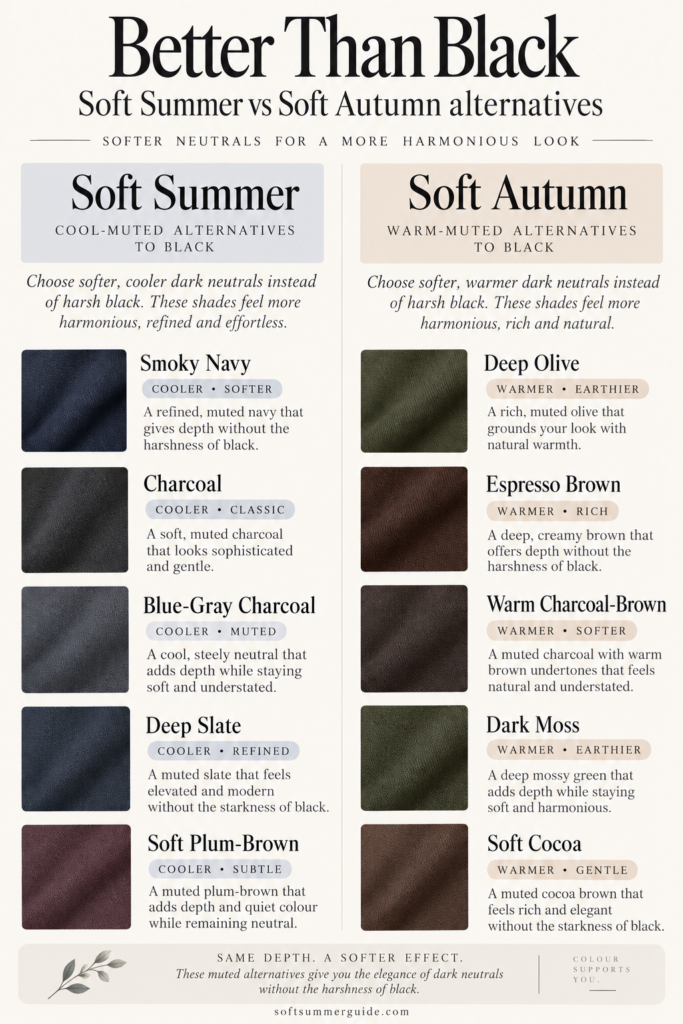
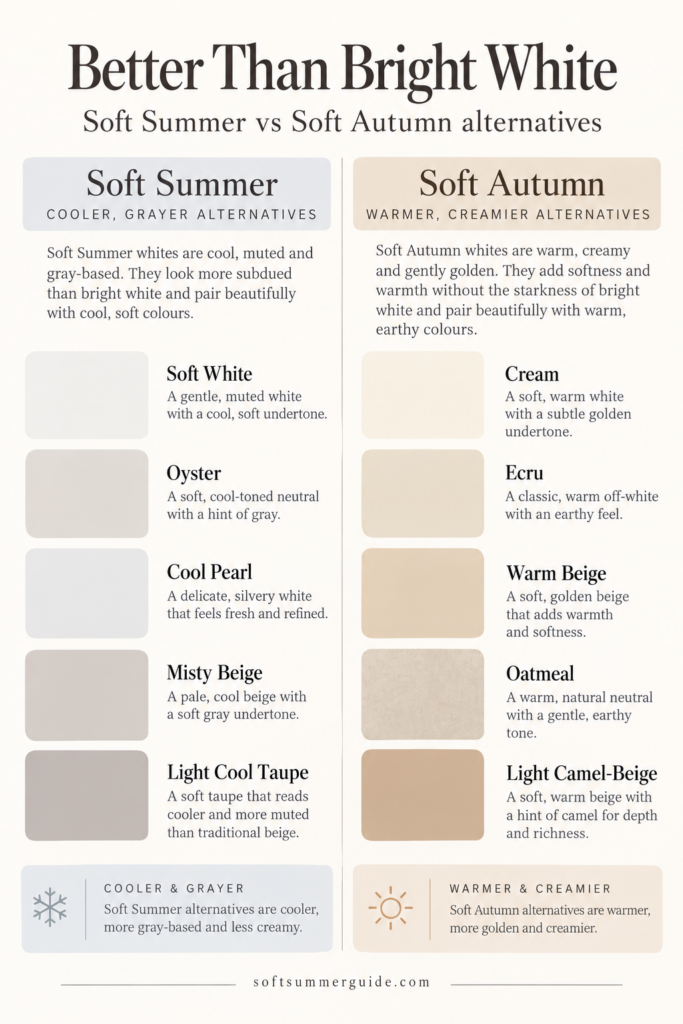
Neither Soft Summer nor Soft Autumn is usually defined by extreme black-and-white contrast.
But the best alternatives tend to differ.
Soft Summer
Try replacing pure black with:
- charcoal
- smoky navy
- deep slate
- muted plum
- Replace optic white with:
- soft white
- oyster
- pearl gray
Soft Autumn
Try replacing pure black with:
- chocolate
- deep olive
- warm charcoal
- espresso
- Replace optic white with:
- cream
- ecru
- warm ivory
This isn’t about banning black.
It’s about noticing whether another dark neutral creates a more natural transition.
Jewelry: Silver or Gold?
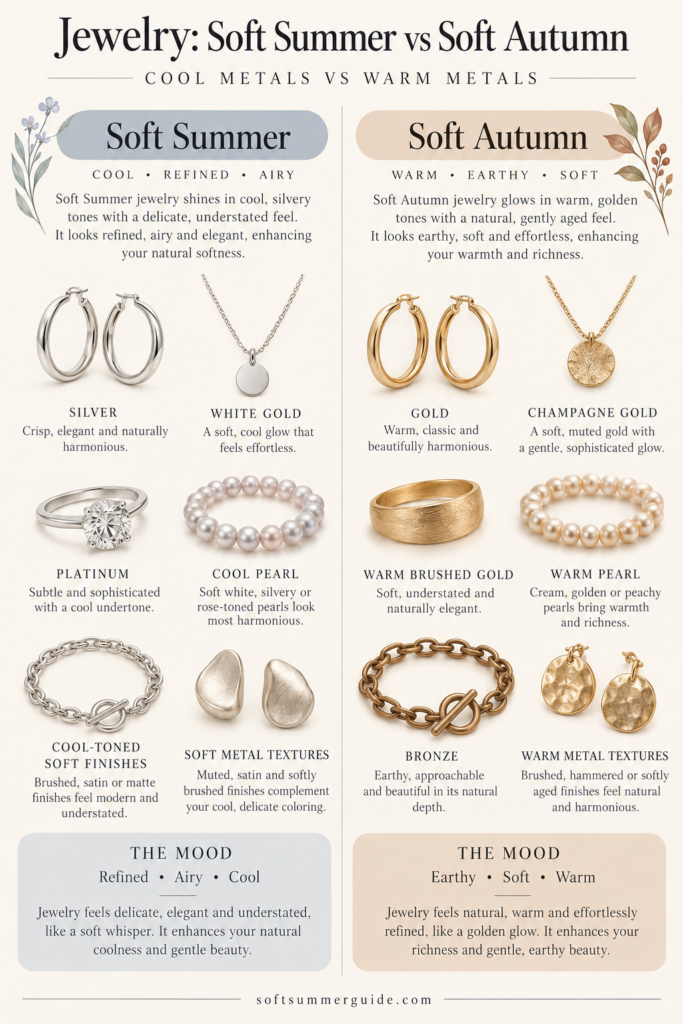
Jewelry can provide another clue, but I would never use it as the only test.
Soft Summer
Often looks harmonious with:
- silver
- pewter
- white gold
- muted cool rose gold
Soft Autumn
Often works beautifully with:
- soft gold
- antique gold
- bronze
- warmer rose gold
The key here is softness again.
Extremely shiny, bright metal can sometimes look stronger than either muted season needs.
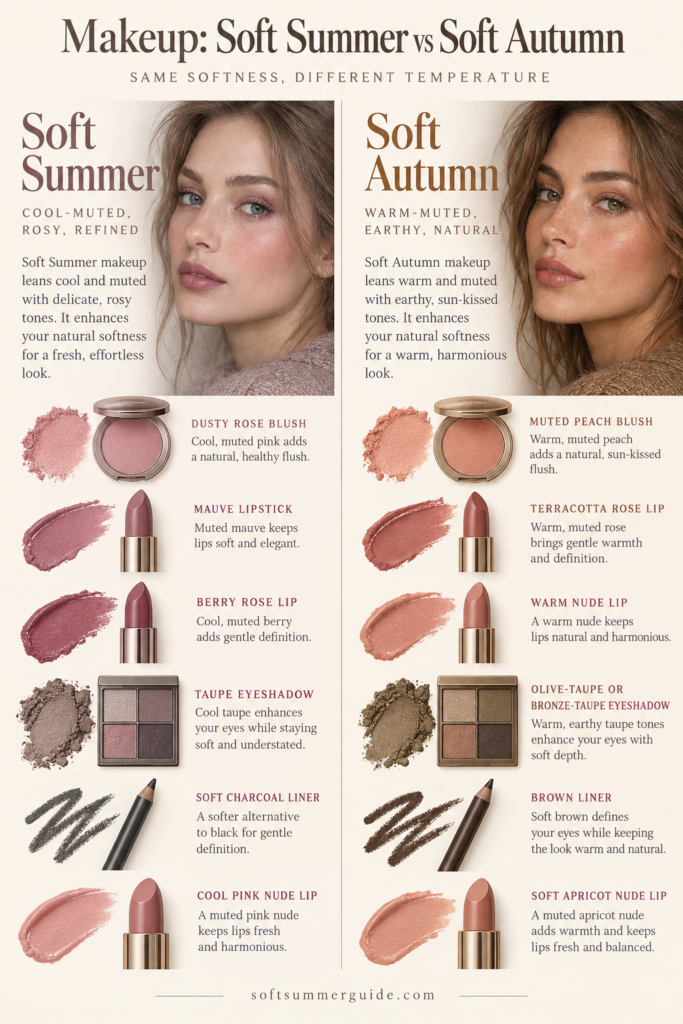
Soft Summer vs Soft Autumn Makeup
Makeup often makes the temperature difference easier to see.
Soft Summer makeup direction
- rosewood lipstick
- mauve
- berry
- cool rose blush
- taupe eyeshadow
- soft charcoal
- gray-brown
Soft Autumn makeup direction
- warm rose
- muted peach
- terracotta rose
- warm taupe
- bronze-brown
- olive brown
- soft cinnamon
If orange-leaning lipstick makes your teeth or skin suddenly appear more yellow, you may lean Soft Summer.
If cooler mauves make you appear gray or drained, Soft Autumn may be more natural.
Want to compare colors more easily?
Go deeper with the Soft Summer Color Guide
The 49-page Color Guide gives you a more detailed visual reference for Soft Summer neutrals, accent colors, darker shades and practical combinations you can use while shopping.
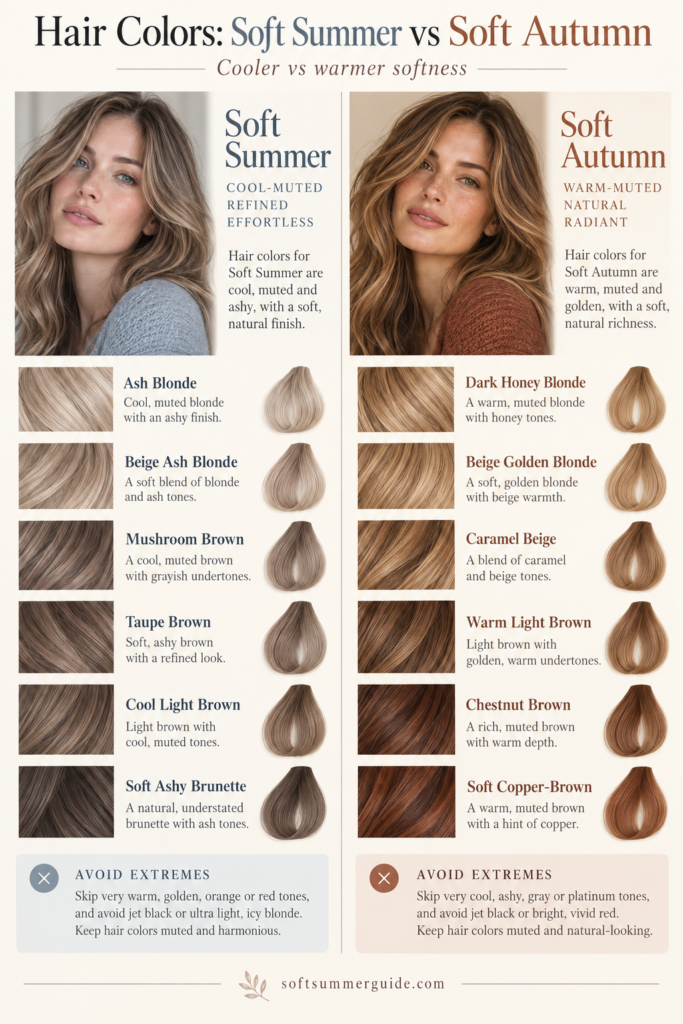
Explore the Color Guide · $19 →Soft Summer vs Soft Autumn: What About Hair Color?
Hair color can support the overall impression, but it should not be used as a strict rule.
Soft Summer hair often appears
- ashy
- smoky
- neutral-cool
- mushroom brown
- taupe brown
- soft brunette
- beige or ash blonde
Soft Autumn hair often appears
- neutral-warm
- golden brown
- soft chestnut
- warm brunette
- caramel brown
- muted golden blonde
But natural hair can change with age, sun exposure and coloring.
So again, hair alone does not decide your season.
Can You Be Between Soft Summer and Soft Autumn?
You may sit very close to the border.
Seasonal color analysis is a system for organizing color relationships, not a biological classification.
Some people clearly lean toward one season.
Others can borrow quite a bit from the neighboring palette.
If you are very neutral, you may find that both seasons contain useful colors.
In that case, don’t force yourself to create a perfect boundary.
Instead ask:
Which direction gives me more reliable colors overall?
Maybe you can wear some Soft Autumn sage and taupe, but Soft Summer dusty blue, mauve, navy and berry work more consistently.
That still makes Soft Summer a useful home palette.
The Mistake That Makes This Comparison Harder
One of the biggest mistakes is comparing colors that differ in more than one characteristic.
For example:
bright cobalt blue vs muted camel.
That doesn’t only compare cool versus warm.
It also compares bright versus muted.
So if you prefer the camel, you don’t know whether warmth helped you — or whether you simply needed softness.
A better comparison is:
- dusty blue vs muted teal
or
- cool taupe vs warm taupe
Try to keep the colors similar in depth and saturation.
Then temperature becomes much easier to judge.
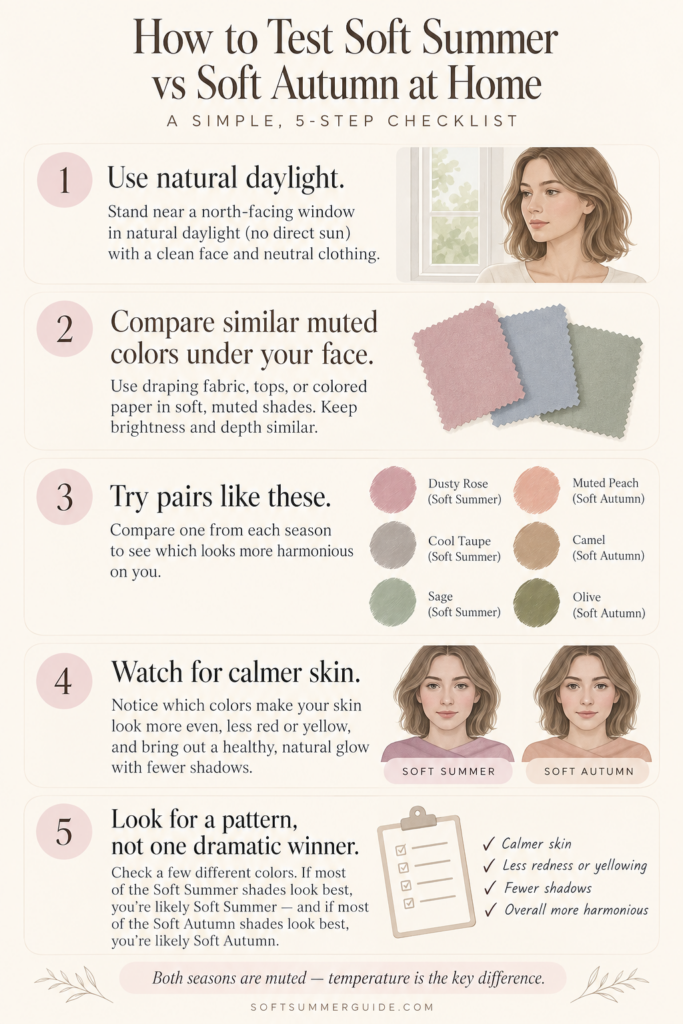
How to Test Soft Summer vs Soft Autumn at Home
Use natural daylight and remove strongly colored makeup if possible.
Then compare pairs of similar colors directly under your face.
Try:
- dusty rose vs muted peach
- cool taupe vs camel
- sage vs olive
- slate blue vs muted teal
- berry vs terracotta
- oyster vs cream
- charcoal vs chocolate brown
You don’t need to find one dramatic winner.
Look for repetition.
If the cool-muted colors win most of the comparisons, Soft Summer is more likely.
If the warm-muted colors repeatedly create more harmony, Soft Autumn is more likely.
What Should You Look for in Your Face?
When a color works well, you may notice:
- more even-looking skin
- less visible redness or yellowing
- fewer distracting shadows
- clearer-looking eyes
- more balanced lips and complexion
- your face appears before the clothing
When a color works less well, you may notice:
- the clothing dominates
- the skin looks unusually yellow, pink or gray
- under-eye shadows become stronger
- redness becomes more visible
- your features seem slightly disconnected
No single sign proves a season.
The pattern matters.
Take the Free Soft Summer Quiz
If Soft Summer still seems possible, you can use my free quiz as another starting point.
It doesn’t rely on one specific hair color or skin-tone stereotype.
Take the free Am I a Soft Summer? Quiz →
What If Soft Autumn Colors Aren’t Bad on Me?
That’s completely possible.
Neighboring seasons naturally overlap.
Soft Summer and Soft Autumn share their strongest characteristic: mutedness.
So you may still look good in some colors from the neighboring season.
The question is not:
“Can I wear this color?”
A more useful question is:
“Which palette gives me more consistently successful choices?”
That is what makes a seasonal palette useful when you shop.
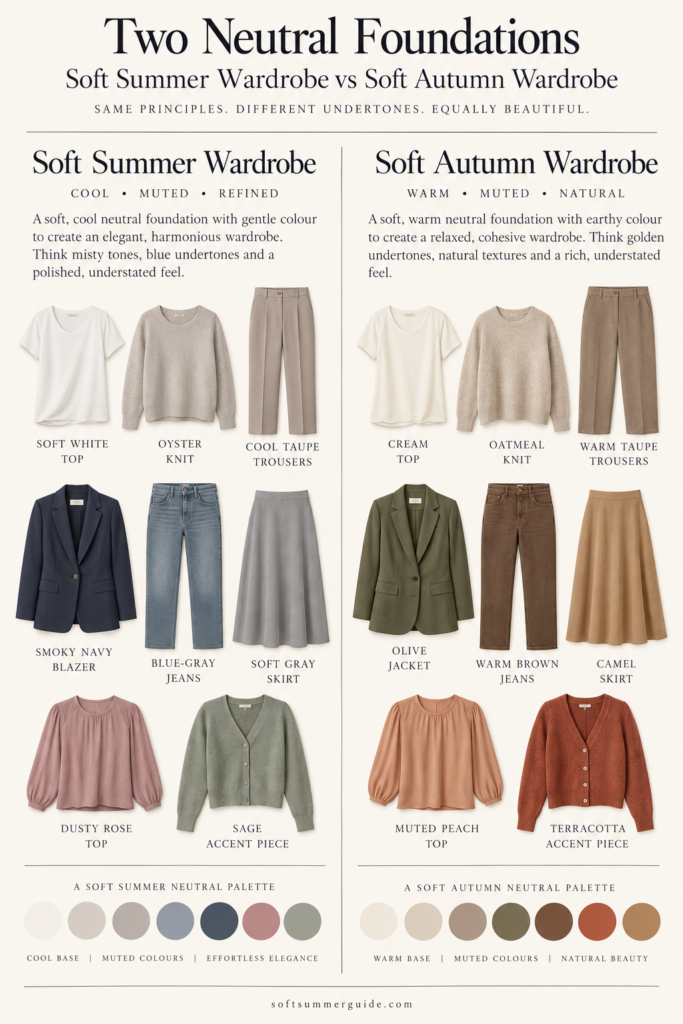
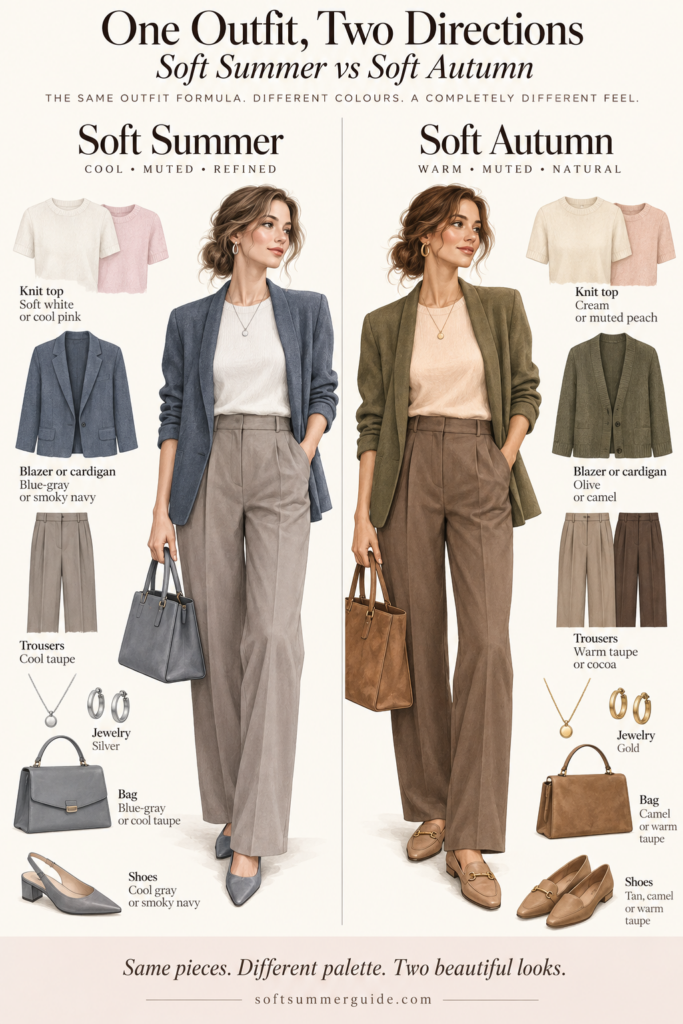
Soft Summer vs Soft Autumn for a Real Wardrobe
This difference becomes especially important when you build a wardrobe.
Imagine two neutral foundations.
Soft Summer wardrobe
- soft white
- cool taupe
- heather gray
- soft navy
- dusty blue
- mauve
Soft Autumn wardrobe
- cream
- camel
- warm taupe
- olive
- muted teal
- terracotta
Both can look elegant.
Both can look subtle.
But mixing both directions randomly can make a wardrobe harder to combine.
For example, a warm camel coat may feel slightly disconnected from cool mauve, dusty blue and smoky gray.
Choosing one main temperature direction gives your closet more cohesion.
Want to start browsing actual products first?
Visit Shop Soft Summer Colors for Soft Summer-friendly searches in neutrals, dusty blues, mauves, taupes, shoes, bags and beauty.
Free Soft Summer resource
Take the Soft Summer Shopping Guide with you
A practical visual reference for your phone so you can compare colors while shopping instead of trusting vague color names.
Get the Free Shopping Guide →Soft Summer vs Soft Autumn: The Simplest Rule to Remember
Both seasons are soft.
The difference is where that softness leans.
Soft Summer = muted + cool-neutral
Soft Autumn = muted + warm-neutral
Don’t rely too heavily on hair, eyes or whether your skin looks “yellow.”
Instead compare muted colors of similar depth directly around your face.
If dusty rose, cool taupe, smoky blue, berry and soft navy repeatedly work better, Soft Summer is the stronger direction.
If muted peach, camel, olive, terracotta and warm teal consistently look more harmonious, Soft Autumn is more likely.
Frequently Asked Questions
Is Soft Summer cooler than Soft Autumn?
Yes. Soft Summer is a cool-neutral season, while Soft Autumn is warm-neutral. Both are primarily muted.
Can Soft Summer have brown hair?
Yes. Brown or darker hair does not exclude Soft Summer. The overall color response matters more than hair color alone.
Can Soft Summer have olive skin?
Yes. Olive-looking or yellow-looking surface skin does not automatically mean Soft Autumn. Comparing cool-muted and warm-muted colors is more reliable.
What is the easiest way to tell Soft Summer from Soft Autumn?
Compare similar muted colors with different temperatures, such as dusty rose vs muted peach or cool taupe vs camel.
Can Soft Summer wear Soft Autumn colors?
Yes. Because the seasons are neighbors, some overlap is normal. Soft Summer may borrow certain muted neutral shades or greens from Soft Autumn, especially if the person’s coloring is very neutral.
Is sage Soft Summer or Soft Autumn?
It depends on the exact sage. A gray, cool-neutral sage can work beautifully for Soft Summer, while warmer, more yellow-green versions lean toward Soft Autumn.
Is taupe Soft Summer or Soft Autumn?
Both seasons can wear taupe. Soft Summer generally suits cooler gray or mushroom taupes, while Soft Autumn tends to suit warmer beige-brown taupes.
Is navy Soft Summer or Soft Autumn?
Softened or smoky navy is especially useful for Soft Summer. Soft Autumn may prefer warmer dark neutrals such as chocolate, olive or warm charcoal.

Still deciding?
Start with comparison — not stereotypes
If muted colors already feel right but you’re unsure whether you lean Summer or Autumn, use the quiz and Starter Guide to look at the whole pattern rather than one feature.
0 Comments